Rehab & Recovery
Dry Needling: What It Is, How It Works & What to Expect
What it is, how it works at the neuromuscular level, what conditions it treats, and what to expect when a thin monofilament needle resets a dysfunctional trigger point.
Medically reviewed by Dr. Michael Gontarek, DC, MSc, DACBN · Updated March 2, 2026
WHAT IS DRY NEEDLING?
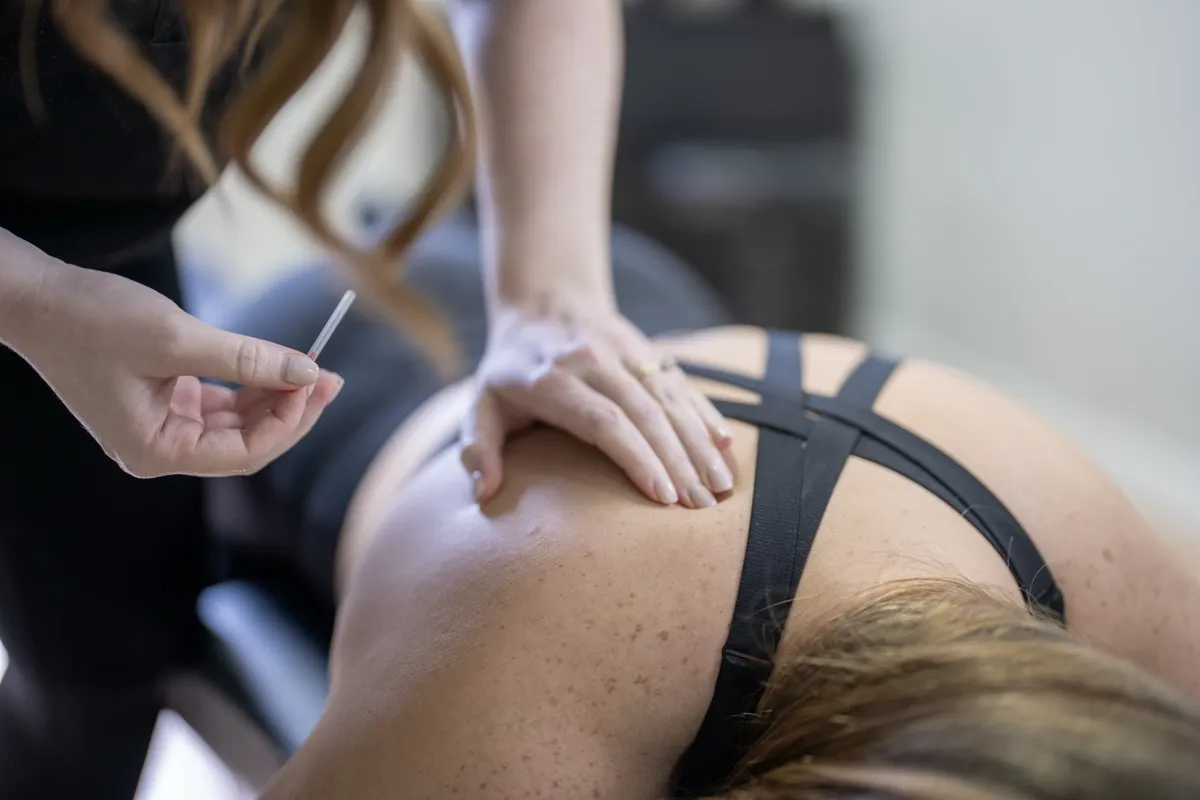
Dry needling is a technique in which a thin, solid, monofilament needle is inserted directly into myofascial trigger points — hyperirritable spots within a taut band of skeletal muscle. The needle is "dry" because nothing is injected. There's no medication, no saline, no anesthetic. The needle itself is the treatment.
These needles are extremely thin — typically 0.16 to 0.30 mm in diameter — and solid, not hollow like a hypodermic needle used for injections or blood draws. The filiform needles are the same type used in acupuncture, but that's where the similarity ends. Dry needling is rooted in modern Western neuroscience and musculoskeletal anatomy, not Traditional Chinese Medicine.
The goal is specific: locate the dysfunctional trigger point, insert the needle, elicit a local twitch response, and reset the neuromuscular environment of that tissue. When it works — and there is a growing body of evidence that it does — the result is reduced pain, restored range of motion, and improved muscle function, often within a single session.
Key distinction: Dry needling is not acupuncture. It uses similar needles, but the theoretical framework, point selection, treatment goals, and clinical training are entirely different. Dry needling targets identifiable musculoskeletal dysfunction. Acupuncture is based on Traditional Chinese Medicine meridian theory and energy flow.
HOW DRY NEEDLING WORKS
A myofascial trigger point is not just a "knot." It's a localized area of muscle where the motor endplate is dysfunctional — stuck in a state of sustained contraction. The sarcomeres (the contractile units of muscle fibers) in the trigger point are maximally shortened, creating a palpable taut band. This contraction compresses local blood vessels, reducing oxygen delivery and waste removal, which creates a self-perpetuating cycle of dysfunction and pain.
When the needle enters this tissue, several things happen in sequence:
1. Local Twitch Response (LTR)
The needle mechanically disrupts the taut band, triggering an involuntary, rapid contraction of the muscle fibers — the local twitch response. This is both diagnostic and therapeutic. The LTR confirms you've hit the trigger point, and the contraction itself begins the process of releasing the sustained shortening. Research by Simons and Hong demonstrated that eliciting the LTR is a key predictor of treatment success.
2. Chemical Environment Reset
The biochemical milieu of a trigger point is measurably different from normal tissue. Shah et al. (2008) demonstrated that active trigger points contain elevated concentrations of substance P, calcitonin gene-related peptide (CGRP), bradykinin, serotonin, norepinephrine, and tumor necrosis factor-alpha. Acetylcholine levels at the dysfunctional motor endplate are abnormally high, maintaining the sustained contraction. The needle disrupts this chemical environment, normalizing the concentrations of these nociceptive and inflammatory mediators.
3. Increased Local Blood Flow
The sustained contraction in a trigger point compresses capillaries, creating local ischemia (reduced blood flow). The twitch response and subsequent relaxation of the taut band restores blood flow to the area, bringing oxygen and nutrients while flushing accumulated metabolic waste products — the same substances that were sensitizing local nociceptors and perpetuating the pain cycle.
4. Endogenous Analgesic Response
Needle insertion activates A-delta and C nerve fibers, which triggers a cascade of endogenous pain-modulating mechanisms. This includes segmental inhibition (gate control theory — the needle stimulus "closes the gate" to pain signals at the spinal cord level), activation of the descending inhibitory pain pathway from the periaqueductal gray matter, and release of endogenous opioids including enkephalins and beta-endorphins. The result is both local and systemic pain reduction.
5. Neuromuscular Reset
By disrupting the dysfunctional motor endplate and normalizing the chemical environment, dry needling effectively resets the neuromuscular feedback loop. The muscle can return to its normal resting length and normal contractile function. This is why patients often notice an immediate improvement in range of motion — the mechanical restriction has been released at the tissue level.
6. Localized Healing Cascade
The micro-trauma from needle insertion initiates a controlled inflammatory and healing response. The body sends platelets, growth factors, and fibroblasts to the needle site. This is similar to the concept behind other micro-trauma therapies (like microneedling for skin or shockwave therapy for tendons) — a small, controlled injury that stimulates the body's own repair mechanisms to address tissue that was stuck in a dysfunctional state.
HOW DRY NEEDLING IS PERFORMED
Dry needling is a hands-on, clinician-driven procedure. There's no machine doing the work. The practitioner's skill in palpation, anatomy knowledge, and needling technique determines the outcome. Here's what the process looks like:
Assessment & Positioning
The session begins with a focused assessment. The clinician identifies the involved muscles based on your symptoms, movement patterns, and pain distribution. You'll be positioned to allow access to the target muscles while keeping you comfortable — this varies depending on the area being treated. For upper trapezius work, you might be seated or prone. For piriformis, you'll likely be side-lying.
Palpation & Trigger Point Identification
This is the most important step. The clinician uses flat palpation or pincer palpation to locate the taut band within the muscle, then identifies the most hyperirritable point within that band — the trigger point. A skilled practitioner can feel the difference between normal tissue, a taut band, and an active trigger point. The palpation itself often reproduces the patient's familiar pain pattern, confirming the correct target.
Needle Insertion & Technique
The clinician uses a guide tube or direct insertion to advance the needle through the skin and into the trigger point. Two primary techniques are used:
Pistoning: The needle is repeatedly advanced and partially withdrawn in a rapid in-and-out motion within the trigger point. This technique is designed to elicit multiple local twitch responses and thoroughly disrupt the dysfunctional tissue. It's the most common technique for deep trigger points.
Fanning: After initial insertion, the needle is redirected at different angles without being fully withdrawn, "fanning" through the trigger point zone. This covers a broader area of the taut band and is often used when the trigger point is diffuse or when multiple closely spaced points are present.
Needle depth varies significantly depending on the muscle group. Superficial muscles like the upper trapezius or temporalis may require only 10-15 mm of depth. Deep muscles like the gluteus medius, piriformis, or multifidus may require 40-60 mm or more. The clinician's anatomical knowledge is critical — knowing what structures lie beneath the needle path at every depth.
Session Parameters
A typical session lasts 15 to 30 minutes. The number of trigger points treated in a single session depends on the patient's tolerance, the severity of the condition, and whether it's a first session or a follow-up. First sessions are typically more conservative — treating 4 to 8 points — to gauge the patient's response and soreness levels. Experienced patients and follow-up sessions may address more points.
The clinician monitors for the local twitch response throughout. Once the twitching in a trigger point diminishes or stops (meaning the taut band has released), the needle is removed from that point and the practitioner moves to the next target.
CONDITIONS TREATED WITH DRY NEEDLING
Dry needling is used for any condition involving myofascial trigger points, muscle tension, or neuromuscular dysfunction. That covers a wide range of musculoskeletal complaints — far more than most people realize.
Chronic Myofascial Pain
The primary indication. Myofascial pain syndrome — persistent pain and dysfunction caused by trigger points — is one of the most common and underdiagnosed sources of musculoskeletal pain. Dry needling directly addresses the pathology.
Tension & Cervicogenic Headaches
Trigger points in the upper trapezius, suboccipital muscles, sternocleidomastoid, and temporalis are well-documented sources of referred headache pain. Dry needling these muscles can reduce headache frequency and intensity, often when other treatments have failed.
Neck & Shoulder Pain
Upper trapezius, levator scapulae, scalenes, infraspinatus, and supraspinatus are among the most commonly needled muscles. These areas are heavily affected by postural stress, desk work, and overhead movements.
Low Back Pain
Trigger points in the quadratus lumborum, multifidus, gluteus medius, and piriformis are common contributors to low back pain that is often misattributed solely to disc pathology. Dry needling these deep muscles can provide relief when stretching and foam rolling can't reach the problem.
Tennis & Golfer's Elbow
Lateral epicondylalgia (tennis elbow) and medial epicondylalgia (golfer's elbow) often involve trigger points in the forearm extensors and flexors. Dry needling the involved muscles — particularly the extensor carpi radialis brevis and common extensor origin — can address the myofascial component that perpetuates these conditions.
TMJ & Jaw Pain
Trigger points in the masseter, temporalis, and lateral pterygoid muscles are major contributors to temporomandibular joint dysfunction, jaw clenching, and associated facial pain. Dry needling these muscles requires precision due to the area's anatomy but can be highly effective.
Plantar Fasciitis
Trigger points in the gastrocnemius, soleus, and intrinsic foot muscles contribute to plantar heel pain. Dry needling the calf musculature and the plantar fascia itself (using a specific technique) has shown effectiveness in cases resistant to conventional treatment.
Rotator Cuff Dysfunction
Infraspinatus, supraspinatus, subscapularis, and teres minor trigger points can mimic or exacerbate rotator cuff pathology. Dry needling is used both as a treatment and as a diagnostic tool — if needling the trigger point resolves the pain pattern, the myofascial component is confirmed.
IT Band Syndrome
Trigger points in the tensor fasciae latae, vastus lateralis, and gluteus maximus contribute to lateral knee pain often attributed to IT band syndrome. Dry needling addresses the muscular drivers rather than just the symptomatic tissue.
Post-Surgical Scar Tissue
Scar tissue and adhesions from surgery can create trigger points and restrict normal movement patterns. Dry needling around and through scar tissue helps remodel collagen fibers, reduce adhesions, and restore mobility in the surrounding musculature.
WHAT THE EVIDENCE SAYS
Dry needling has a substantial and growing evidence base. Unlike many manual therapy techniques that rely primarily on clinical experience, dry needling has been evaluated in systematic reviews and randomized controlled trials across multiple conditions. Here's what the research shows:
Systematic Reviews & Meta-Analyses
A 2013 systematic review by Cagnie et al. in Physical Therapy examined the evidence for dry needling in the management of myofascial trigger points in the upper quarter (neck, shoulder, and upper back). The review found consistent evidence that dry needling reduces pain and improves function in these regions.
Espejo-Antunez et al. (2017) conducted a systematic review and meta-analysis in the Journal of Pain Research evaluating dry needling for tension-type headaches. The analysis found significant reductions in headache frequency, intensity, and duration compared to sham needling and control groups.
A Cochrane-style systematic review by Gattie et al. (2017) published in the Journal of Orthopaedic & Sports Physical Therapy evaluated dry needling for musculoskeletal conditions and concluded that dry needling is more effective than sham or placebo for pain reduction in the short and medium term, with moderate-quality evidence supporting its use.
Randomized Controlled Trials (RCTs)
Neck pain: Liu et al. (2015) published an RCT in Medicine comparing dry needling to sham needling in patients with chronic neck pain. The dry needling group showed statistically significant improvements in pain (VAS) and disability (NDI) scores at both short-term and 3-month follow-up.
Low back pain: Koppenhaver et al. (2015) published an RCT in the Journal of Orthopaedic & Sports Physical Therapy showing that dry needling of the multifidus muscle in patients with low back pain produced immediate improvements in muscle thickness (measured by ultrasound), reduced disability, and decreased pain. The multifidus is a deep spinal stabilizer that is extremely difficult to target with manual therapy alone.
Lateral epicondylalgia: Uygur et al. (2017) compared dry needling to corticosteroid injection for lateral epicondylalgia. Both groups showed improvement, but the dry needling group demonstrated more sustained long-term outcomes without the tissue degradation risks associated with repeated steroid injections.
Plantar heel pain: Cotchett et al. (2014) conducted a sham-controlled RCT published in the British Journal of Sports Medicine demonstrating that dry needling of the plantar fascia and calf muscles produced significant pain reduction compared to sham needling at 6-week follow-up.
Mechanistic Research
The most foundational mechanistic work comes from Shah et al. (2005, 2008) at the National Institutes of Health. Using microdialysis needles inserted into active trigger points, they measured the biochemical environment before and after dry needling. They demonstrated that active trigger points contain significantly elevated levels of inflammatory and nociceptive chemicals — and that eliciting a local twitch response normalizes these concentrations toward baseline. This was the first direct biochemical evidence explaining why dry needling works.
Hong (1994) established that obtaining a local twitch response during needling is critical for therapeutic effect. Patients in whom a twitch response was elicited had significantly better outcomes than those in whom it was not.
The bottom line: Dry needling is not a fringe technique with anecdotal support. It has systematic reviews, RCTs, and mechanistic research supporting its use for myofascial pain, headaches, neck pain, low back pain, and extremity conditions. The evidence is strongest for pain reduction and improved range of motion in the short to medium term, especially when combined with exercise and manual therapy.
DRY NEEDLING VS. ACUPUNCTURE
This is the most common question. They look similar — both use thin filiform needles. But they are fundamentally different approaches based on entirely different frameworks.
Dry Needling
Theoretical framework: Modern Western neuroscience, musculoskeletal anatomy, and neurophysiology.
Point selection: Based on palpation of myofascial trigger points — identifiable, reproducible, anatomically defined points of muscle dysfunction.
Goal: Elicit a local twitch response, release the taut band, normalize the neurochemical environment, and restore normal muscle function.
Training: Postgraduate training for licensed healthcare providers (physical therapists, chiropractors, MDs) with focus on anatomy, trigger point identification, and safe needling technique.
Diagnosis model: Based on musculoskeletal assessment, movement analysis, and pain science.
Acupuncture
Theoretical framework: Traditional Chinese Medicine (TCM), based on the concept of qi (energy) flowing through meridians (channels) in the body.
Point selection: Based on TCM meridian theory — predetermined points along energy channels selected to influence the flow of qi and restore energetic balance.
Goal: Restore the flow and balance of qi throughout the body's meridian system to treat disease and dysfunction.
Training: Master's degree in acupuncture or Traditional Chinese Medicine (typically 3-4 years), with focus on TCM theory, meridian systems, and holistic diagnosis.
Diagnosis model: Based on TCM assessment including tongue and pulse diagnosis, pattern identification, and energetic imbalance.
Neither is "better" in an absolute sense — they're different tools with different paradigms. But if your problem is a palpable trigger point in your upper trapezius that's causing headaches and restricting your neck range of motion, dry needling targets that specific pathology directly. The needle goes into the dysfunctional tissue because the tissue is dysfunctional — not because it sits on a meridian line.
WHAT TO EXPECT DURING AND AFTER
Knowing what to expect removes uncertainty and makes the experience significantly better. Here's an honest breakdown:
During the Session
Needle insertion: The needle passing through the skin is often barely felt — many patients say they didn't know the needle was in until the twitch response happens. The filiform needle is thin enough that the insertion is less painful than a standard blood draw or injection.
The twitch response: This is what you'll feel. When the needle hits the trigger point, the muscle will visibly and involuntarily contract — a quick, localized twitch or jump. It feels like a brief deep cramp or a flick inside the muscle. It lasts a fraction of a second but can be startling the first time. Some patients describe it as uncomfortable but not painful; others feel a deep aching or cramping sensation that resolves within seconds.
Multiple points: The clinician will typically treat several trigger points in a session, moving between muscles based on your presentation. Some twitches will be stronger than others depending on the irritability of the trigger point.
Immediate effects: Many patients notice increased range of motion and reduced pain immediately after the needles are removed. You may feel a sense of heaviness or relaxation in the treated area — the muscle has just released a sustained contraction it may have been holding for weeks or months.
After the Session
Soreness (24-48 hours): Post-treatment soreness is normal and expected. It feels like the deep soreness you get after a hard workout — not sharp pain, but a dull ache in the treated muscles. This is the result of the micro-trauma and local inflammatory response that's part of the healing process. It typically resolves within 24 to 48 hours.
Bruising: Some bruising is possible, particularly in areas with more superficial blood vessels or in patients who bruise easily. Minor bruising is cosmetic and resolves on its own within a few days.
Fatigue: Some patients feel a general sense of fatigue or relaxation after treatment, especially after the first session. This is a normal systemic response to the neurophysiological changes triggered by the treatment.
Improved range of motion: Increased range of motion and reduced pain are often noticeable the same day. Full therapeutic benefit typically builds over 2-3 sessions as the treated muscles maintain their restored length and the neuromuscular system recalibrates.
Post-treatment recommendations: Stay hydrated, move gently through the day (don't immobilize the treated area), and apply heat rather than ice if the area feels sore. Avoid intense exercise targeting the treated muscles for 24 hours. The goal is to let the muscle settle into its new, restored resting state.
COMMON QUESTIONS
Is dry needling painful?
Most patients describe the needle insertion itself as barely noticeable — the needles are extremely thin (0.16-0.30 mm), much thinner than a hypodermic needle. What you will feel is the local twitch response: a brief, involuntary muscle contraction that can feel like a deep cramp or a flick inside the muscle. It lasts a fraction of a second. Some people find the twitch uncomfortable but tolerable; others barely notice it. Soreness similar to a deep workout is common for 24-48 hours afterward.
How many sessions will I need?
It depends on the condition, how long it's been present, and how your body responds. Acute issues may resolve in 2-4 sessions. Chronic conditions like long-standing myofascial pain or tension headaches often require 4-8 sessions over several weeks, sometimes with periodic maintenance. Many patients notice improvement after the first or second session — especially in range of motion and pain reduction.
Who is qualified to perform dry needling?
Licensing varies by state. In most states, dry needling can be performed by physical therapists, chiropractors, and medical doctors who have completed specific postgraduate training in the technique. Training typically involves coursework in musculoskeletal anatomy, trigger point identification, needling technique, and safety protocols, plus supervised clinical hours. Always verify that your provider has completed accredited dry needling training.
Can dry needling be combined with other treatments?
Yes — and it often works best that way. Dry needling is frequently combined with manual therapy, corrective exercise, chiropractic adjustments, and rehabilitation protocols. The needling resets the dysfunctional tissue, and the complementary treatments reinforce proper movement patterns and address underlying biomechanical issues. For injuries that need additional recovery support, BPC-157 peptide therapy can complement dry needling by promoting tissue repair at the cellular level. At Moonshot, dry needling is part of an integrated rehab and recovery approach, not a standalone treatment.
Is dry needling covered by insurance?
Coverage varies by insurance plan and state. Some insurance plans cover dry needling when performed by a licensed provider (such as a physical therapist or chiropractor) as part of a treatment plan for a diagnosed condition. Others do not. It is increasingly recognized, but coverage is not universal. Check with your insurance provider for specifics. At Moonshot, we can help you understand your options.
Are there any contraindications?
Yes. Dry needling is generally not performed on patients with bleeding disorders or who are on anticoagulant therapy (without medical clearance), patients with needle phobia that would prevent tolerating the procedure, areas with active skin infection or open wounds, patients who are immunocompromised (relative contraindication), or directly over implants or prostheses. Pregnancy is a relative contraindication for certain areas. Your provider will screen for these before treatment.
References
- 1. Shah JP, et al. "Biochemicals associated with pain and inflammation are elevated in sites near to and remote from active myofascial trigger points." Arch Phys Med Rehabil. 2008;89(1):16-23.
- 2. Hong CZ. "Lidocaine injection versus dry needling to myofascial trigger point: the importance of the local twitch response." Am J Phys Med Rehabil. 1994;73(4):256-263.
- 3. Cagnie B, et al. "Evidence for the use of ischemic compression and dry needling in the management of trigger points of the upper trapezius in patients with neck pain." Am J Phys Med Rehabil. 2015;94(7):573-583.
- 4. Gattie E, Cleland JA, Snodgrass S. "The effectiveness of trigger point dry needling for musculoskeletal conditions by physical therapists: a systematic review and meta-analysis." J Orthop Sports Phys Ther. 2017;47(3):133-149.
- 5. Koppenhaver SL, et al. "Changes in multifidus muscle function and nociceptive sensitivity following dry needling of the lumbar multifidus in participants with low back pain." J Orthop Sports Phys Ther. 2015;45(10):839-848.
- 6. Cotchett MP, Munteanu SE, Landorf KB. "Effectiveness of trigger point dry needling for plantar heel pain: a randomized controlled trial." Phys Ther. 2014;94(8):1083-1094.
- 7. Liu L, et al. "Effectiveness of dry needling for myofascial trigger points associated with neck and shoulder pain: a systematic review and meta-analysis." Arch Phys Med Rehabil. 2015;96(5):944-955.
- 8. Espejo-Antunez L, et al. "Dry needling in the management of myofascial trigger points: a systematic review of randomized controlled trials." Complement Ther Med. 2017;33:46-57.
- 9. Simons DG, Travell JG, Simons LS. "Travell & Simons' Myofascial Pain and Dysfunction: The Trigger Point Manual." 2nd ed. Baltimore: Williams & Wilkins; 1999.
- 10. Dommerholt J, Fernandez-de-las-Penas C. "Trigger Point Dry Needling: An Evidence and Clinical-Based Approach for the Management of Musculoskeletal Pain." Edinburgh: Churchill Livingstone/Elsevier; 2013.
DEALING WITH CHRONIC PAIN OR TENSION?
Dry needling targets the source of myofascial pain at the tissue level. If stretching, foam rolling, and massage aren't getting the job done, this might be the missing piece.
Book Consultation