Peptides & Performance
NAD+ & Vitamin Injections: Benefits & Evidence
What NAD+ is, why it matters at the cellular level, how injectable nutrients bypass the gut for direct delivery, and what the research actually shows about their effects on energy, recovery, and aging.
Medically reviewed by Missy Zammichieli, DNP, APRN, FNP-BC · Updated March 2, 2026
WHAT IS NAD+?
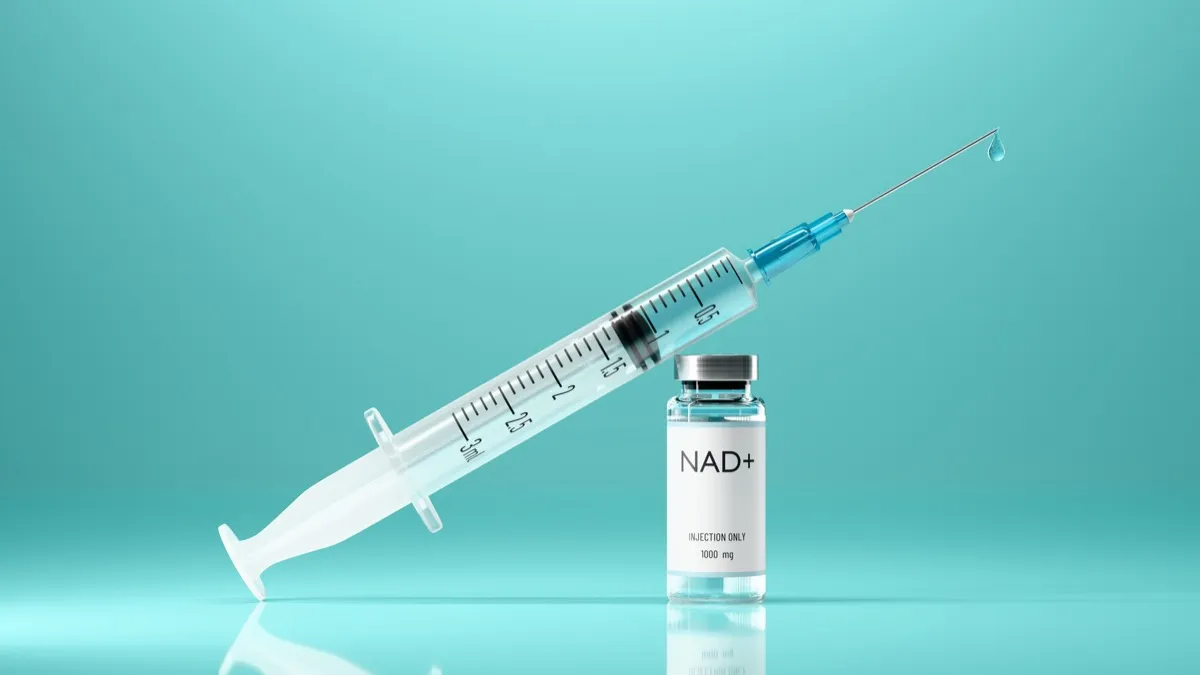
NAD+ stands for nicotinamide adenine dinucleotide. It is a coenzyme found in every living cell in your body. Without it, you would be dead in about 30 seconds. That is not hyperbole. NAD+ is required for the most fundamental metabolic processes that keep cells alive and functioning.
NAD+ exists in two forms: NAD+ (the oxidized form) and NADH (the reduced form). The ratio between these two forms drives some of the most critical biochemical reactions in your body. When NAD+ accepts electrons during metabolic reactions, it becomes NADH. When NADH donates those electrons (primarily in the mitochondrial electron transport chain), it becomes NAD+ again. This cycling is the engine of cellular energy production.
But NAD+ is not just an energy molecule. It is a master regulator involved in at least five critical cellular functions:
Mitochondrial Energy Production
NAD+ is a required substrate in glycolysis, the citric acid cycle (Krebs cycle), and the electron transport chain. These are the pathways that convert the food you eat into ATP, the energy currency of every cell. Without adequate NAD+, these pathways slow down. The result is reduced ATP output, which manifests as fatigue, poor exercise recovery, and diminished cellular function across every organ system.
Sirtuin Activation (Longevity Genes)
Sirtuins (SIRT1-7) are a family of enzymes that regulate gene expression, inflammation, stress resistance, and cellular repair. They are sometimes called "longevity genes" because their activation is associated with lifespan extension in animal models. Here is the critical point: sirtuins are NAD+-dependent enzymes. They literally cannot function without NAD+ as a co-substrate. When NAD+ levels drop, sirtuin activity drops with it. This is one of the proposed mechanisms linking NAD+ decline to accelerated aging.
PARP-Mediated DNA Repair
PARP enzymes (poly ADP-ribose polymerases) are the frontline repair crews for DNA damage. Every day, your cells sustain tens of thousands of DNA lesions from normal metabolic activity, UV exposure, oxidative stress, and environmental toxins. PARP enzymes detect and repair this damage. Like sirtuins, PARPs require NAD+ to function. When NAD+ is depleted, DNA repair capacity declines. Accumulated unrepaired DNA damage is a hallmark of aging and a driver of cancer risk.
Circadian Rhythm Regulation
NAD+ levels oscillate in a 24-hour cycle, and this oscillation is tightly linked to circadian clock gene expression. SIRT1 (NAD+-dependent) directly interacts with the core circadian machinery, including CLOCK and BMAL1. Declining NAD+ disrupts this interplay, contributing to the sleep disturbances, altered metabolism, and impaired recovery commonly seen with aging. It is a feedback loop: poor circadian function further impairs NAD+ synthesis, and low NAD+ further disrupts the clock.
Neurotransmitter Synthesis & Immune Signaling
NAD+ is involved in the synthesis of neurotransmitters and in immune cell signaling through CD38 and CD157 enzymes. CD38, in particular, is one of the largest consumers of NAD+ in the body, and its expression increases with age and chronic inflammation. This creates a vicious cycle: inflammation increases CD38 activity, which depletes NAD+, which impairs the cellular repair and immune regulation that would resolve the inflammation.
The age problem: NAD+ levels decline significantly with age. Research estimates a roughly 50% decline by age 60. This decline correlates with reduced mitochondrial function, impaired DNA repair, decreased sirtuin activity, and the metabolic dysfunction that characterizes aging. The question driving current research: can restoring NAD+ levels slow or reverse these processes?
WHY INJECTABLE VS. ORAL
The supplement industry sells billions of dollars of oral NAD+ precursors every year. NMN (nicotinamide mononucleotide) and NR (nicotinamide riboside) are the most popular. They are legitimate molecules with real science behind them. But there is a bioavailability problem that most marketing conveniently ignores.
When you take oral NAD+ directly, most of it is broken down in the gastrointestinal tract before it ever reaches your bloodstream. The molecule is too large and too unstable to survive gastric acid and intestinal enzymes intact. Oral NMN and NR fare better because they are smaller precursor molecules that the body can convert into NAD+ after absorption. But even here, the conversion is multi-step and inefficient. You absorb a fraction of what you swallow, and then that fraction has to go through hepatic first-pass metabolism and enzymatic conversion before it becomes usable NAD+ in your cells.
Injectable NAD+ bypasses all of this. The full dose enters the bloodstream directly, skipping the gastrointestinal tract, skipping first-pass liver metabolism, and delivering NAD+ to tissues at concentrations that oral supplementation simply cannot achieve.
Oral NAD+ / NMN / NR
Must survive stomach acid and intestinal enzymes. Absorbed through the gut lining (variable depending on gut health). Undergoes first-pass metabolism in the liver. Requires multi-step enzymatic conversion to become NAD+. Bioavailability estimates vary widely, but a significant portion of the ingested dose never reaches target tissues as NAD+.
Injectable NAD+
Bypasses the entire GI tract. No first-pass metabolism. Full dose enters systemic circulation. Achieves plasma concentrations not possible with oral dosing. No dependency on gut health, intrinsic factor, or enzymatic conversion.
B12: The Same Logic
Vitamin B12 (cobalamin) oral absorption requires intrinsic factor, a protein produced by parietal cells in the stomach. Approximately 15% of the general population has some degree of intrinsic factor deficiency. Patients on metformin (common in diabetes and increasingly used off-label) have reduced B12 absorption. Patients with any GI dysfunction, inflammatory bowel conditions, or history of gastric surgery may absorb a fraction of oral B12. Injectable B12 bypasses all of these variables.
An important caveat: Not everything needs to be injected. If you have normal gut function and adequate intrinsic factor, oral B12 supplementation works fine. If you eat a nutrient-dense diet, you may not need supplemental injections at all. Injectable delivery makes the most sense for nutrients where oral absorption is the documented bottleneck, or for patients with known absorption issues. This is targeted intervention, not a blanket replacement for oral supplementation.
WHAT WE OFFER
At Moonshot Medical, injectable nutrient therapy is part of a broader optimization approach. These are not standalone "wellness shots" sold at a juice bar. They are clinical tools used alongside lab work, hormone optimization, and performance programming to address specific deficiencies and support defined physiological goals.
NAD+ Injections
What it targets: Cellular energy production, mitochondrial function, DNA repair, sirtuin-mediated gene regulation, and the metabolic decline associated with aging.
Who it is for: Patients experiencing age-related energy decline, athletes looking to optimize recovery and mitochondrial output, patients on hormone therapy who want to support the metabolic pathways those hormones activate, and anyone with documented markers of NAD+ insufficiency or accelerated biological aging.
How it is administered: Subcutaneous injection or intravenous infusion, depending on dose and protocol. Subcutaneous is faster (approximately 5 minutes) with lower peak plasma concentrations. IV allows higher doses and sustained delivery over 30-60 minutes.
Pricing: $60 per injection. Hormone optimization members receive 1 vitamin injection per month included in their membership.
B12 Injections (Methylcobalamin / Cyanocobalamin)
What it targets: Energy metabolism, red blood cell production, nervous system function, methylation pathways, and homocysteine regulation.
Who it is for: Patients with documented B12 deficiency (more common than most people realize), patients on metformin, patients with GI absorption issues, vegetarians/vegans (B12 is found almost exclusively in animal products), and patients with elevated homocysteine levels.
Why inject: B12 deficiency is often a function of absorption, not intake. You can eat adequate B12 and still be deficient if intrinsic factor or gut absorption is compromised. Injectable B12 is the standard medical treatment for documented deficiency, not an alternative therapy.
Included with hormone optimization: Moonshot Medical hormone optimization members receive 1 vitamin injection per month included in their membership. This is designed to complement the metabolic support that hormone therapy provides. NAD+ in particular supports the same mitochondrial and cellular repair pathways that optimized hormone levels activate. For patients interested in other injectable optimization therapies, peptide therapy targets specific goals like tissue repair, growth hormone release, and sexual health through different mechanisms.
WHAT THE EVIDENCE SAYS
Honesty matters here. NAD+ science is one of the most active areas of aging research, with legitimate, well-funded labs producing real data. But the field is at different stages of maturity depending on what you are looking at. Here is a straightforward assessment of where the evidence stands.
Strong: NAD+ Decline With Age
This is well-established. Multiple studies have documented the age-related decline of NAD+ in human tissues. Massudi et al. (2012) demonstrated declining NAD+ levels in human skin tissue with age. Camacho-Pereira et al. (2016) identified CD38 as a primary driver of age-related NAD+ depletion. Zhu et al. (2015) confirmed the relationship between NAD+ decline and mitochondrial dysfunction. The "what" is not in question. NAD+ goes down as you get older, and this decline correlates with impaired cellular function.
Strong: Animal Models of NAD+ Restoration
Animal data is robust. Rajman, Chwalek, and Sinclair (2018) published a comprehensive review in Cell Metabolism documenting how NAD+ boosting in mice reverses mitochondrial dysfunction, improves metabolic function, extends lifespan, and protects against neurodegeneration. Yoshino et al. (2011, 2018) demonstrated that NMN supplementation in mice reverses age-associated metabolic decline, improves insulin sensitivity, and restores mitochondrial function. Mills et al. (2016) showed long-term NMN administration mitigated age-associated physiological decline in mice without toxicity.
Emerging: Human Clinical Trials
This is where you need to be realistic. Human clinical trial data is accumulating but not yet definitive for many of the claimed benefits. Yoshino et al. (2021) published a randomized, placebo-controlled trial in Science showing that NMN supplementation increased NAD+ metabolites and improved muscle insulin sensitivity in prediabetic postmenopausal women. Liao et al. (2021) demonstrated that NR supplementation safely elevated NAD+ levels in middle-aged and older adults. Several Phase I and Phase II trials are ongoing for NAD+ precursors in aging, neurodegeneration, and metabolic disease. The safety profile is favorable. The efficacy data for specific clinical endpoints is still being built.
Established: B12 Injection Therapy
B12 injection evidence is on different footing entirely. Injectable B12 is the standard of care for pernicious anemia and documented B12 deficiency. This is not emerging science. It is established medical practice backed by decades of clinical evidence. The only question is whether patients without documented deficiency benefit from supraphysiologic B12 levels, and there the evidence is less clear.
The bottom line: The cellular biology of NAD+ is well-understood. The age-related decline is documented. The animal data is compelling. The human clinical data is promising and growing but not yet at the level of large-scale, long-term randomized controlled trials for all endpoints. We believe the mechanistic rationale is strong enough to offer NAD+ therapy to appropriate patients, while being transparent that the field is still maturing. This is not "proven to reverse aging." It is a biologically plausible intervention with a favorable safety profile and accumulating evidence. That is an honest framing.
WHO SHOULD CONSIDER NAD+ INJECTIONS
NAD+ therapy is not for everyone. It is most relevant for patients whose symptoms, age, or clinical context suggest that declining NAD+ levels may be contributing to their complaints. Here are the profiles that benefit most:
Chronic Fatigue
Persistent fatigue that does not resolve with sleep, nutrition, and basic bloodwork optimization. If mitochondrial output is the bottleneck, NAD+ addresses the substrate deficiency directly.
Athletes & Active Individuals
Athletes with high training volumes place enormous demands on mitochondrial function and cellular repair. NAD+ supports the energy systems and recovery pathways that high-output training requires.
Age 40+
The age-related decline in NAD+ is measurable and progressive. Patients over 40 are in the window where NAD+ levels have dropped enough to potentially affect mitochondrial function, DNA repair capacity, and sirtuin activity.
Patients on Hormone Therapy
Optimized testosterone, thyroid, or peptide therapy activates metabolic pathways that require NAD+ as a co-substrate. Think of NAD+ as the fuel for the engine that hormones are tuning. Without adequate NAD+, hormone optimization may not reach its full potential.
Brain Fog & Cognitive Decline
The brain is one of the most metabolically demanding organs, consuming roughly 20% of the body's energy. NAD+ depletion in neural tissue is implicated in cognitive decline, and preclinical research shows NAD+ restoration improves neuronal function in animal models.
Post-Illness Recovery
Acute illness and systemic inflammation consume NAD+ at accelerated rates (via PARP and CD38 activation). Patients recovering from significant illness may have depleted NAD+ reserves that are slow to rebuild through diet alone.
Think NAD+ could help? Book a consultation to discuss whether it's right for your protocol.
Book ConsultationWHAT TO EXPECT
If you have never had an NAD+ injection, knowing what to expect removes the uncertainty. Here is an honest breakdown of the experience.
Administration Methods
Subcutaneous injection: A small injection just under the skin, typically in the abdomen or upper arm. Takes about 5 minutes. Lower peak plasma concentrations than IV, but faster and more convenient. Most patients tolerate this well with minimal side effects.
Intravenous (IV) infusion: Delivered directly into the vein via a slow drip. Takes 30 to 60 minutes depending on the dose. Allows higher doses and produces higher peak plasma concentrations. More likely to cause the transient flushing and warmth that are characteristic of NAD+ delivery. The infusion rate is adjusted based on patient tolerance.
During the Injection
What you may feel: NAD+ infusions commonly produce a sensation of warmth, flushing (especially in the chest and face), and sometimes mild nausea or a feeling of chest tightness. This is a direct pharmacological effect of NAD+ entering the bloodstream rapidly. It is not dangerous. It is temporary, resolving within minutes of slowing or completing the infusion.
Managing it: Slowing the infusion rate is the primary way to reduce these sensations. An experienced provider adjusts the rate to keep you comfortable. Subcutaneous injections produce less of this effect because the absorption is more gradual.
After the Injection
Immediate: Any flushing or warmth resolves within minutes. Most patients feel normal or slightly energized. Some report a sense of mental clarity shortly after.
Over days and weeks: NAD+ therapy is not a single-dose treatment. The effects are cumulative. Many patients report noticeable improvements in energy, mental clarity, and exercise recovery within 1 to 2 weeks of regular injections. A typical loading protocol is 1 to 2 injections per week for 2 to 4 weeks, followed by weekly or biweekly maintenance.
What it is not: NAD+ is not a stimulant. You will not feel "wired" or experience a crash. The energy improvements are metabolic, not adrenal. They come from improved mitochondrial output, not from cortisol or catecholamine release.
B12 injections are simpler: A quick intramuscular injection, typically in the deltoid. Takes 30 seconds. Minimal side effects beyond occasional soreness at the injection site. Effects on energy are usually noticed within a few days, especially in patients who were deficient.
WHAT THE CRITICS SAY — AND WHY WE STILL OFFER IT
NAD+ therapy has vocal critics, and some of their points are worth taking seriously.
Science-Based Medicine has called the evidence for NAD+ therapy "not persuasive." Peter Attia has noted that the NIA's Interventions Testing Program found no lifespan benefit from NAD precursors in mice. Mayo Clinic has categorized IV vitamin therapy broadly as a "health fad." These are not fringe voices — they represent legitimate skepticism rooted in the gap between mechanistic promise and definitive clinical proof.
There is also the bioavailability question. Some researchers argue that most IV NAD+ is rapidly broken down into nicotinamide once it enters the bloodstream, raising the question of whether direct NAD+ supplementation meaningfully raises tissue NAD+ levels any better than cheaper oral precursors. This is an active area of research, and the answer is not fully settled.
Why Moonshot still offers it: The biological rationale is strong. NAD+ decline with age is well-documented and correlates with measurable declines in mitochondrial function, DNA repair, and sirtuin activity. The safety profile is favorable at clinical doses. Patient-reported improvements in energy, cognition, and recovery are consistent across our practice. And we frame it honestly — as a biologically plausible intervention with accumulating evidence, not a proven cure.
We believe patients deserve honest framing, not hype. If the evidence changes, our recommendations will too.
COMMON QUESTIONS
What does NAD+ actually do?
NAD+ (nicotinamide adenine dinucleotide) is a coenzyme in every living cell. It is essential for energy production (mitochondrial function), DNA repair, gene expression regulation (sirtuins), and cellular signaling. Levels decline 50%+ by age 60. Low NAD+ means impaired energy, slower recovery, and accelerated aging at the cellular level.
Why inject instead of taking a pill?
Oral NAD+ supplements have very poor bioavailability. Most is broken down in the gut before reaching cells. Injectable NAD+ bypasses digestion entirely, delivering the full dose directly to the bloodstream. The same logic applies to B12: oral absorption depends on intrinsic factor and gut health, which many people have issues with. Injectable delivery solves the absorption bottleneck.
Who benefits most from NAD+ injections?
People experiencing fatigue, slow recovery from exercise, brain fog, or signs of accelerated aging. Athletes looking to optimize recovery. Patients on hormone therapy, since NAD+ supports the metabolic pathways that hormones activate. Anyone over 40 with declining energy that is not explained by other factors.
How often should I get NAD+ injections?
Typical protocol is 1-2x per week during an initial loading phase (2-4 weeks), then 1x weekly or biweekly for maintenance. Some patients transition to monthly maintenance once they have reached their goals. At Moonshot, hormone optimization members get 1 vitamin injection per month included in their membership.
Are there side effects?
NAD+ injections can cause flushing, warmth, mild nausea, or chest tightness during the injection. This is temporary and resolves within minutes. Slowing the injection rate reduces these effects significantly. B12 injections have minimal side effects beyond occasional soreness at the injection site. Both have favorable safety profiles when administered by trained providers.
References
- 1. Rajman L, Chwalek K, Sinclair DA. "Therapeutic Potential of NAD-Boosting Molecules: The In Vivo Evidence." Cell Metab. 2018;27(3):529-547.
- 2. Yoshino J, Mills KF, Yoon MJ, Imai S. "Nicotinamide mononucleotide, a key NAD+ intermediate, treats the pathophysiology of diet- and age-induced diabetes in mice." Cell Metab. 2011;14(4):528-536.
- 3. Yoshino J, Baur JA, Imai S. "NAD+ Intermediates: The Biology and Therapeutic Potential of NMN and NR." Cell Metab. 2018;27(3):513-528.
- 4. Yoshino M, Yoshino J, Kayser BD, et al. "Nicotinamide mononucleotide increases muscle insulin sensitivity in prediabetic women." Science. 2021;372(6547):1224-1229.
- 5. Mills KF, Yoshida S, Stein LR, et al. "Long-Term Administration of Nicotinamide Mononucleotide Mitigates Age-Associated Physiological Decline in Mice." Cell Metab. 2016;24(6):795-806.
- 6. Camacho-Pereira J, Tarragó MG, Chini CCS, et al. "CD38 Dictates Age-Related NAD Decline and Mitochondrial Dysfunction through an SIRT3-Dependent Mechanism." Cell Metab. 2016;23(6):1127-1139.
- 7. Massudi H, Grant R, Braidy N, et al. "Age-associated changes in oxidative stress and NAD+ metabolism in human tissue." PLoS One. 2012;7(7):e42357.
- 8. Liao B, Zhao Y, Wang D, Zhang X, Hao X, Hu M. "Nicotinamide mononucleotide supplementation enhances aerobic capacity in amateur runners: a randomized, double-blind study." J Int Soc Sports Nutr. 2021;18(1):54.
- 9. Zhu XH, Lu M, Lee BY, Ugurbil K, Chen W. "In vivo NAD assay reveals the intracellular NAD contents and redox state in healthy human brain and their age dependences." Proc Natl Acad Sci USA. 2015;112(9):2876-2881.
- 10. Imai S, Guarente L. "NAD+ and sirtuins in aging and disease." Trends Cell Biol. 2014;24(8):464-471.
NAD+ INJECTIONS IN PARK RIDGE & CHICAGO'S NORTHWEST SUBURBS
Moonshot Medical and Performance
542 Busse Hwy
Park Ridge, IL 60068
- No referral needed — book directly online
- In-person care — not a telehealth vitamin mill
- Minutes from O'Hare — right off the Kennedy Expressway
- Co-located with Moonshot CrossFit — integrated recovery
Serving the Northwest Suburbs
Patients come to Moonshot for NAD+ and vitamin injections from across the northwest Chicago suburbs:
- Des Plaines, Niles, Edison Park
- Morton Grove, Glenview, Skokie
- Chicago and surrounding communities
Easily accessible from all NW suburbs. Free parking on-site.
READY TO OPTIMIZE AT THE CELLULAR LEVEL?
NAD+ and vitamin injections are one piece of a comprehensive performance and longevity approach. If you are dealing with fatigue, slow recovery, or age-related decline, let's find out what is actually going on and address it at the source.
Book Consultation