Body Composition Guide
DEXA SCAN vs BOD POD
Both claim to measure body composition. But they work differently, measure different things, and one gives you significantly more useful data than the other.
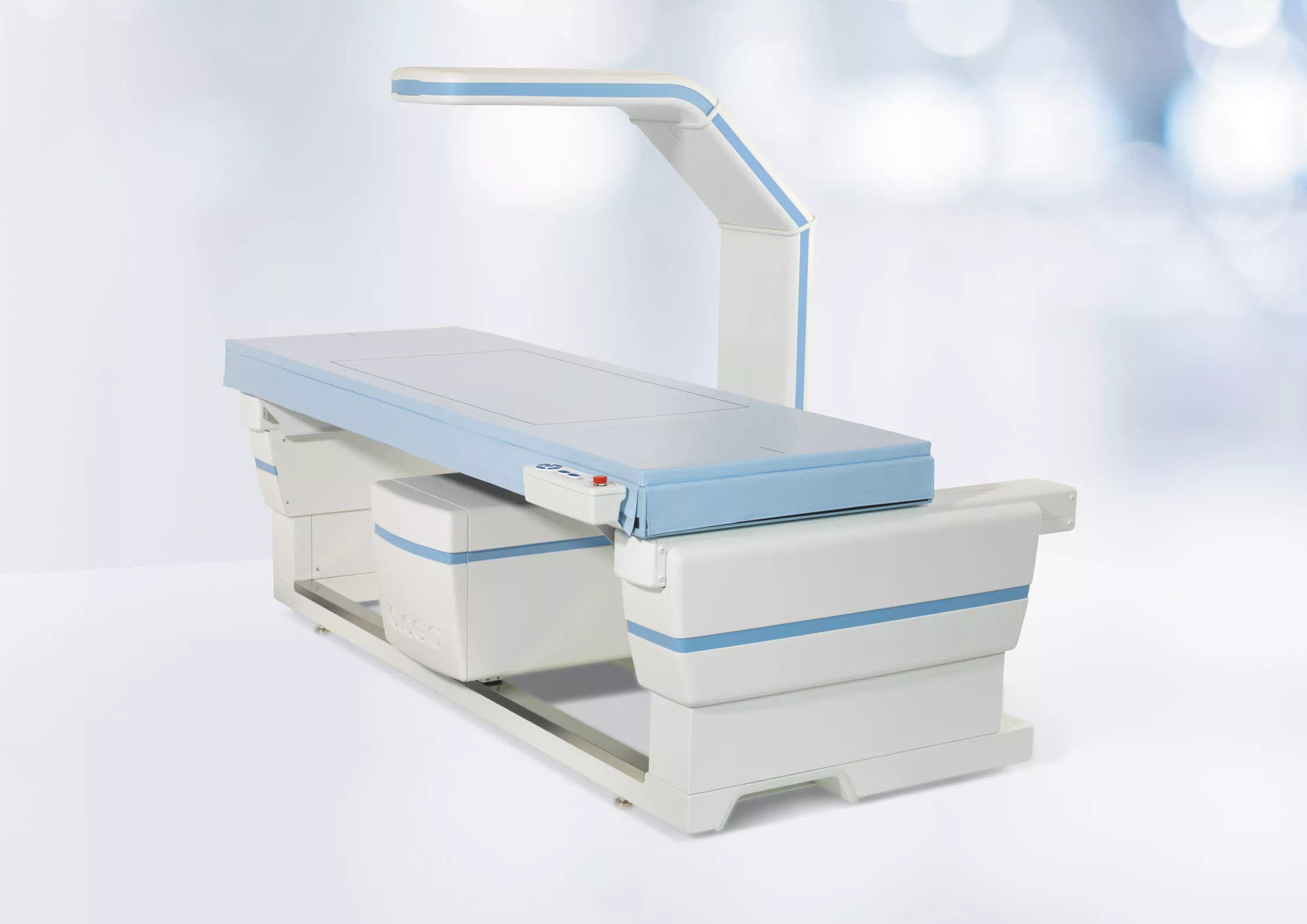
SIDE-BY-SIDE COMPARISON
| Feature | DEXA Scan | Bod Pod |
|---|---|---|
| Technology | Dual-energy X-ray absorptiometry | Air displacement plethysmography |
| Accuracy | <2% error | 2-4% error |
| Body Fat % | Yes | Yes |
| Regional Muscle Mass | Yes — each arm, leg, trunk | No |
| Visceral Fat | Yes — directly measured | No |
| Bone Density | Yes — T-scores included | No |
| Fat Distribution Map | Yes — android/gynoid ratio | No |
| Muscle Symmetry | Yes — left vs right | No |
| Scan Time | 7 minutes | 5 minutes |
| Clothing | Athletic wear (no metal) | Tight clothing or swimsuit |
| Typical Cost | $100-200 | $45-75 |
HOW EACH METHOD WORKS
DEXA Scan
DEXA (Dual-Energy X-Ray Absorptiometry) passes two low-dose X-ray beams through your body. Different tissues—fat, muscle, bone—absorb the beams differently. The scanner measures these differences to create a precise, pixel-by-pixel map of your body composition.
This is a 3-compartment model: it separately identifies fat mass, lean soft tissue, and bone mineral content. It also measures where each tissue type is located—giving you regional data for each arm, each leg, and your trunk.
You lie on a padded table for about 7 minutes. The scanner arm passes over you. No enclosure, no discomfort.
Bod Pod
The Bod Pod (technically called a COSMED BOD POD) uses air displacement plethysmography. You sit inside an egg-shaped chamber, and the machine measures your body volume by tracking changes in air pressure.
Using your body volume and weight, it calculates body density. Then it applies an equation (usually Siri or Brozek) to estimate body fat percentage. This is a 2-compartment model: fat mass vs. everything else (fat-free mass).
You sit in the sealed chamber wearing tight-fitting clothing or a swimsuit for about 5 minutes. Some people find the enclosure uncomfortable.
WHY THE DIFFERENCE MATTERS
Bod Pod can't tell you where your fat is
Bod Pod gives you one number: total body fat percentage. It can't tell you whether your fat is stored around your organs (visceral fat, which is dangerous) or under your skin (subcutaneous fat, which is less concerning). DEXA separates these and gives you a visceral adipose tissue (VAT) measurement—one of the strongest predictors of metabolic disease.
Bod Pod can't measure muscle by region
If you're training, you want to know whether you're building muscle symmetrically. If you're recovering from injury, you want to track whether your affected side is catching up. Bod Pod tells you total fat-free mass. DEXA tells you exactly how much lean tissue is in your left arm vs right arm, each leg, and your trunk.
Bod Pod doesn't measure bone density
DEXA was originally developed as a bone density test. Every body composition scan includes bone mineral density data with T-scores. This matters for osteoporosis screening, especially for women post-menopause and men on certain medications. Bod Pod provides no bone data at all.
Bod Pod accuracy depends on assumptions
Bod Pod calculates body fat from body density using prediction equations. These equations assume standard tissue densities—but actual tissue density varies between individuals based on hydration, ethnicity, age, and fitness level. This introduces variability. DEXA directly measures tissue composition without relying on density assumptions.
WHEN EACH METHOD MAKES SENSE
Use DEXA when:
- + You want the most accurate body fat measurement
- + You need to track regional muscle gain or fat loss
- + You want visceral fat data
- + You want bone density screening
- + You're on TRT, GLP-1s, or any protocol where body composition changes are the goal
- + You're making decisions based on the data
If bone density is the part you're weighing — particularly for women in or past perimenopause or men over 50 — our free 2-minute fracture risk screener uses FRAX-aligned risk factors to tell you whether a baseline scan is worth booking.
Bod Pod is fine when:
- - You just want a rough body fat estimate
- - Cost is the primary factor
- - You don't need regional data or bone density
- - You're tracking general trends over time
COMMON MISCONCEPTIONS
"Bod Pod is just as accurate as DEXA"
Bod Pod and DEXA both have good test-retest reliability (consistency between scans). But Bod Pod's absolute accuracy depends on density assumptions that don't hold for everyone. Research shows Bod Pod can overestimate or underestimate body fat by 2-4% compared to DEXA, and the error isn't always in the same direction. For tracking changes, consistency matters more than absolute accuracy—but DEXA gives you both.
"DEXA radiation makes Bod Pod safer"
DEXA exposes you to about 1-4 microsieverts—roughly the radiation you get eating 2 bananas or spending a few hours outdoors. It's less than a single chest X-ray. The radiation concern with DEXA is effectively a non-issue for the frequency of scanning anyone would do (every 3-6 months). Bod Pod uses no radiation, which is its one genuine advantage, but the radiation from DEXA is negligible.
"You can compare Bod Pod results to DEXA results"
Different methods, different measurements. A body fat percentage from Bod Pod and DEXA aren't directly comparable—they use different technology and different models. If you want to track progress over time, pick one method and stick with it. If you're choosing which to start with, DEXA gives you more data to work with.
WHAT WE ACTUALLY FIND ON A DEXA SCAN
Real patterns from the people we scan in Park Ridge — not textbook averages.
Of 69 patients, 47.8% had visceral fat above 100 cm² — the metabolically dangerous fat around your organs that you can’t see, pinch, or catch on a scale, and that a “normal” weight often hides.
Based on visceral adipose tissue area from DEXA scans of 69 Moonshot Medical patients; >100 cm² = elevated metabolic risk. Reflects patients who came to us for scans, not the general population. Aggregate, de-identified clinic data; individual results vary.
Median body fat is 24% for men and 34% for women — and about 1 in 11 had a “normal” BMI while carrying body fat in the high range. The scale and BMI miss this; a DEXA scan doesn’t.
Based on total body-fat % from DEXA scans of 69 Moonshot Medical patients (median). “Normal BMI, high body fat” = BMI under 25 with body fat above 25% (men) / 32% (women). Reflects patients who came to us for scans; individual results vary.
COMMON QUESTIONS
Is a DEXA scan more accurate than a Bod Pod?
Yes. DEXA scans use dual-energy X-ray technology to directly measure fat, lean tissue, and bone with less than 2% error. Bod Pod uses air displacement plethysmography to estimate two compartments (fat mass vs fat-free mass) with 2-4% error. DEXA also measures bone density, visceral fat, and regional body composition—none of which Bod Pod can provide.
What does a Bod Pod measure vs a DEXA scan?
Bod Pod measures two things: fat mass and fat-free mass (everything that isn't fat). DEXA measures three: fat mass, lean soft tissue (muscle), and bone mineral content. DEXA also provides regional breakdowns (each arm, leg, trunk), visceral fat measurement, bone density scores, and fat distribution mapping.
How much does a Bod Pod test cost vs DEXA?
Bod Pod tests typically cost $45-75 per session. DEXA scans range from $100-200. At Moonshot Medical in Park Ridge, IL, a DEXA scan is $150. The price difference reflects the additional data DEXA provides—bone density, visceral fat, regional muscle mass, and fat distribution that Bod Pod cannot measure.
Can a Bod Pod measure visceral fat?
No. Bod Pod cannot differentiate between visceral fat (fat around your organs) and subcutaneous fat (fat under your skin). It only reports total body fat percentage. DEXA directly measures visceral adipose tissue (VAT), which is one of the strongest predictors of metabolic disease and cardiovascular risk.
Where can I get a DEXA scan near Chicago?
Moonshot Medical and Performance at 542 Busse Hwy, Park Ridge, IL 60068 has a Hologic Horizon DEXA scanner on-site. No referral needed—book directly online. Serving Park Ridge, Des Plaines, Niles, Chicago, Morton Grove, Glenview, Skokie, and the northwest suburbs.
GET THE FULL PICTURE
Medical-grade DEXA on a Hologic Horizon. Body fat, muscle mass, bone density, visceral fat—all in 7 minutes.
$150 | Park Ridge, IL | No referral needed
Book DEXA Scan