Body Composition Guide
HOW TO READ YOUR DEXA SCAN RESULTS
Your DEXA report has a lot of data. Here's what each number means, what ranges to target, and how to use the information to actually improve.
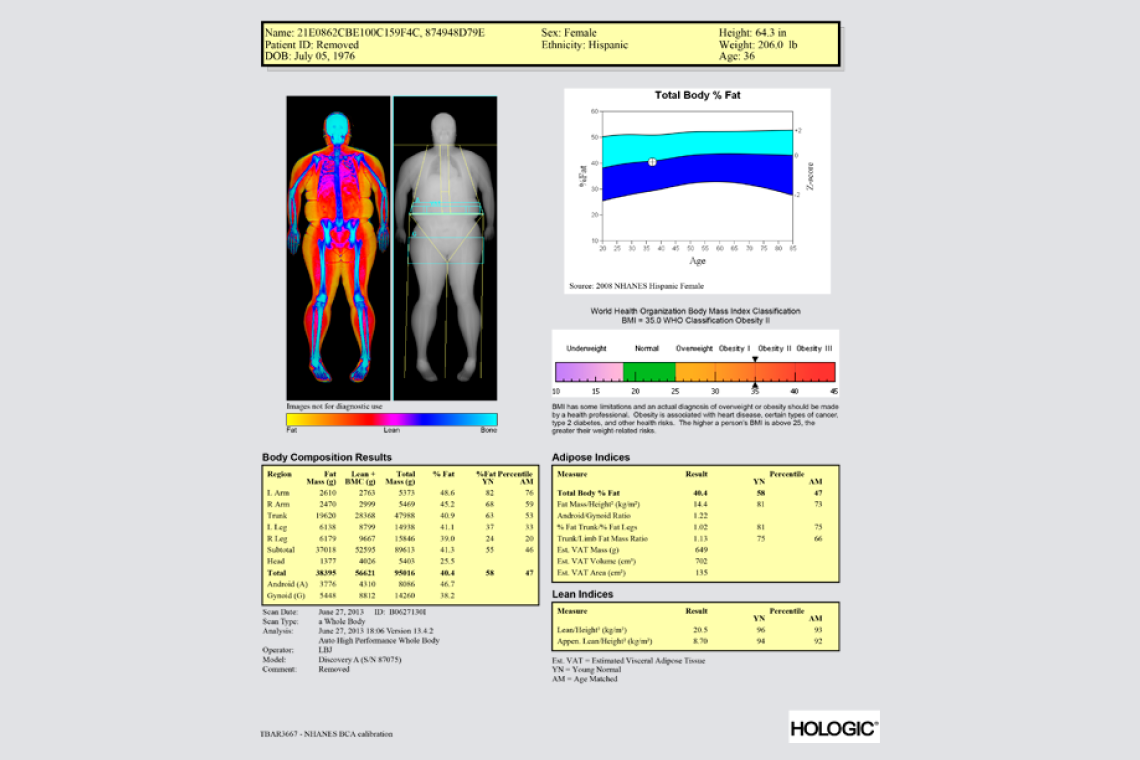
TOTAL BODY FAT PERCENTAGE
This is the headline number most people look at first. It tells you what percentage of your total body mass is fat tissue.
Men — Body Fat Ranges
Women — Body Fat Ranges
Important: DEXA body fat percentages read 3-5% higher than most other methods. If your smart scale said 18%, DEXA might say 22%. This doesn't mean you got fatter—DEXA is measuring fat that other methods miss (intramuscular fat, visceral fat). The DEXA number is the accurate one.
LEAN MASS & REGIONAL BREAKDOWN
Your DEXA report shows lean soft tissue mass for your total body and for each region: left arm, right arm, left leg, right leg, and trunk.
This is one of DEXA's biggest advantages. No other accessible body composition test gives you this level of regional detail.
What to look for:
- 1. Total lean mass — Is it going up over time? If you're training and optimizing hormones, lean mass should be trending upward.
- 2. Left vs right symmetry — Small differences (5-10%) between sides are normal. Larger imbalances may indicate compensation patterns or old injuries.
- 3. Appendicular lean mass index (ALMI) — Your limb lean mass divided by height squared. Low ALMI is associated with sarcopenia (pathological muscle loss). Your provider can calculate this from your DEXA data.
Why Lean Mass Matters More Than Weight
Two people can weigh 180 lbs and look completely different. The difference is lean mass vs fat mass.
Lean mass drives your metabolism. Each pound of muscle burns roughly 6 calories per day at rest, compared to 2 calories per pound of fat. More muscle means a higher resting metabolic rate.
If you're on a GLP-1 weight loss program, tracking lean mass is critical. You want to ensure you're losing fat, not muscle. DEXA is the only way to confirm this with precision.
BONE MINERAL DENSITY & T-SCORES
Your DEXA scan measures bone mineral density (BMD) and reports it as a T-score—a comparison to peak bone density of a healthy 30-year-old of your sex.
Who should pay attention to bone density:
- Women post-menopause (estrogen decline accelerates bone loss)
- Men over 50 (testosterone decline affects bone density)
- Anyone on corticosteroids or certain medications
- People with a family history of osteoporosis
- Anyone with a history of fractures
Catching osteopenia early means you can intervene with weight-bearing exercise, nutrition, and potentially hormone optimization before it progresses to osteoporosis.
VISCERAL ADIPOSE TISSUE (VAT)
Visceral fat is stored around your organs in the abdominal cavity. You can't see it or pinch it. It's metabolically active and produces inflammatory compounds that increase your risk of type 2 diabetes, cardiovascular disease, and metabolic syndrome.
This is one of the most important numbers on your DEXA report—and one that no other consumer body composition method can give you accurately.
DEXA reports visceral fat as a mass (grams) or volume (cm³). Some reports also give a VAT area measurement. Your provider will help you interpret what your number means relative to risk thresholds.
Why Visceral Fat Matters
Two people with the same body fat percentage can have very different health risk profiles based on where that fat is stored.
Subcutaneous fat (under your skin) is relatively benign. Visceral fat (around your organs) is linked to:
- Insulin resistance and type 2 diabetes
- Cardiovascular disease
- Chronic inflammation
- Non-alcoholic fatty liver disease
- Increased all-cause mortality
The good news: visceral fat responds well to exercise, dietary changes, and targeted interventions like GLP-1 medications (which preferentially reduce visceral fat).
ANDROID/GYNOID RATIO (A/G RATIO)
Your DEXA report may include an A/G ratio—the ratio of fat stored in your android region (belly/trunk) vs gynoid region (hips/thighs).
Android fat (belly)
Fat stored centrally, around the midsection. Higher android fat is associated with greater metabolic risk regardless of total body fat percentage.
Gynoid fat (hips/thighs)
Fat stored in the lower body. This fat pattern is less metabolically risky and may even be somewhat protective.
Rule of thumb: An A/G ratio above 1.0 means you carry more fat centrally than in your lower body—a higher risk distribution pattern. Below 1.0 is generally better from a metabolic health standpoint. The ratio matters because someone with 25% body fat and an A/G of 0.8 has a different risk profile than someone at 25% with an A/G of 1.3.
WHAT TO DO WITH YOUR RESULTS
Establish your baseline
Your first DEXA scan is your starting point. Don't judge it—use it. Now you have real data to measure against. Every scan after this will show you exactly what changed, where it changed, and by how much.
Focus on the right numbers
Total body fat percentage gets the most attention, but lean mass and visceral fat are equally (or more) important. The best outcome from a body recomposition is: fat goes down, lean mass goes up or stays stable, visceral fat drops. DEXA tracks all three.
Scan again in 3-6 months
Bodies change slowly. Give yourself enough time between scans to see real changes. If you're on a hormone optimization or weight loss program, scanning every 3-4 months gives you clear feedback on whether the protocol is working.
Use consistent conditions
For the most accurate scan-to-scan comparisons: same time of day, similar hydration state, similar clothing, and same DEXA machine. Small variables compound across scans if you're not consistent.
KNOW YOUR NUMBERS
Get your DEXA baseline at Moonshot Medical in Park Ridge.
$150 | 7-minute scan | Results same day
Book DEXA Scan