Clinical disclaimer: Retatrutide is an investigational medication not yet approved by the FDA. This article discusses published trial data, known pharmacology, and established bone physiology for educational purposes. It is not a recommendation to use retatrutide or any specific medication. All treatment decisions should be made with a licensed medical provider based on your individual health status.
Retatrutide · Bone Health
RETATRUTIDE & BONE DENSITY
Rapid weight loss reduces mechanical loading on your skeleton. That's a bone density problem nobody talks about until it's too late. Here's what the data says and how to protect yourself.
Medically reviewed by Missy Zammichieli, DNP, APRN, FNP-BC · Published April 5, 2026
THE BONE DENSITY PROBLEM NOBODY TALKS ABOUT
When people start a GLP-1 weight loss medication, the conversation is about fat loss, muscle preservation, side effects, and cost. Bone density almost never comes up. It should.
Your skeleton is not a static structure. It's a living organ system that constantly remodels itself in response to the mechanical forces placed on it. When you weigh 240 pounds, your bones experience 240 pounds of gravitational loading with every step, every squat, every time you stand up from a chair. Your body responds by maintaining bone density sufficient to handle that load.
When you lose 50 pounds on a GLP-1 medication, your bones now experience 190 pounds of loading. The skeleton registers the reduced demand and downregulates bone formation accordingly. This is not a drug side effect. It is a fundamental principle of bone physiology called Wolff's Law — bone adapts to the loads placed upon it. Remove the load, and bone density decreases.
The faster you lose weight, the less time your skeleton has to adapt gradually. And with retatrutide producing up to 24% total body weight loss in Phase 2 trials — the most of any obesity drug tested — the mechanical unloading effect is proportionally larger.
The key distinction: There is no evidence that retatrutide or other GLP-1 medications are directly toxic to bone. The bone density concern is entirely about the indirect effect of reduced mechanical loading from weight loss. This means it's predictable, measurable, and — with the right protocol — manageable.
WHY WEIGHT LOSS AFFECTS BONE DENSITY
Bone density is maintained through a balance between two cell types: osteoblasts (which build new bone) and osteoclasts (which break down old bone). In a healthy adult, these processes are roughly balanced. Mechanical loading tips the balance toward formation. Reduced loading tips it toward resorption.
Weight loss affects this balance through several mechanisms:
Reduced Mechanical Loading
The primary driver. Less body mass means less gravitational force on the skeleton with every movement. The bones at highest risk are weight-bearing sites — hip, femoral neck, lumbar spine — which experience the most significant reduction in load.
Caloric Deficit Effects
Sustained caloric restriction reduces circulating IGF-1 and other anabolic signals that support bone formation. The deeper and more prolonged the deficit, the more pronounced this effect. GLP-1 medications create sustained deficits through appetite suppression.
Nutrient Absorption Changes
Reduced food intake means reduced calcium and vitamin D intake from dietary sources. GLP-1 medications also alter gut transit time, which may affect mineral absorption. Without deliberate supplementation, micronutrient deficiencies compound the mechanical unloading effect.
Adipose Tissue & Estrogen
Fat tissue produces estrogen via aromatase activity. Estrogen is a key bone-protective hormone. Significant fat loss reduces peripheral estrogen production, which can contribute to bone resorption — particularly relevant for postmenopausal women who have already lost ovarian estrogen production.
None of these mechanisms are unique to GLP-1 medications. They occur with any form of significant weight loss — surgical, dietary, or pharmacological. But the speed and magnitude of GLP-1-mediated weight loss makes the bone density question more urgent. Losing 5% of body weight over a year is one thing. Losing 20%+ in the same timeframe is a categorically different mechanical and hormonal shift.
WHAT THE GLP-1 BONE DENSITY DATA SHOWS
The best bone density data we have comes from the semaglutide and tirzepatide clinical programs, which included DEXA measurements at weight-bearing skeletal sites.
-1 to -2%
Hip BMD change over 68 weeks in STEP trials (semaglutide 2.4mg)
-0.7 to -1.5%
Lumbar spine BMD change reported across GLP-1 programs
Dose-dependent
Greater weight loss correlates with greater BMD reduction
To put these numbers in context: a healthy adult loses roughly 0.5-1% of bone mineral density per year after age 50 as part of normal aging. A 1-2% BMD decrease at the hip over 68 weeks of GLP-1 treatment is roughly equivalent to 1-2 additional years of age-related bone loss compressed into about 16 months.
For a 35-year-old with normal bone density, this is clinically manageable. For a 58-year-old postmenopausal woman whose BMD is already in the osteopenic range, that same 1-2% drop could push her across the osteoporosis threshold — with meaningful implications for fracture risk.
The important nuance: these bone density changes were generally not associated with increased fracture rates in the trials. But the trials were not designed or powered to detect fracture differences, and the treatment durations (48-72 weeks) may be too short to see fracture signal. Bone density loss accumulates. The clinical consequences may take years to manifest.
The overlooked comparison: Bariatric surgery produces even larger bone density decreases (3-8% at the hip over 1-2 years), and the orthopedic community has long recognized this as a manageable risk. The point is not that GLP-1 bone effects are alarming — it's that they should be monitored and managed, not ignored.
RETATRUTIDE-SPECIFIC CONSIDERATIONS
Retatrutide produced up to 24.2% total body weight loss at 48 weeks in Phase 2 trials — the highest of any obesity drug in clinical development. That's roughly 50-60 pounds for a 240-pound individual. The mechanical unloading effect on bone is proportional to total weight lost, which means the bone density question is more relevant for retatrutide than for any previous GLP-1 medication.
Dedicated bone density endpoints from retatrutide trials have not been published as extensively as the body composition data. The TRIUMPH-4 substudy focused on fat mass and lean mass via DEXA but did not emphasize skeletal site BMD as a primary outcome. This is a data gap.
What we can say mechanistically:
The Glucagon Component: Mixed Implications
Retatrutide's glucagon receptor activity increases resting energy expenditure and promotes fat oxidation. This is favorable for body composition (more fat loss relative to lean mass). But glucagon also stimulates hepatic glucose output and can influence calcium metabolism. Animal studies suggest chronic glucagon receptor activation may affect bone remodeling, though the clinical significance in humans at therapeutic doses is not yet established.
Greater Weight Loss = Greater Unloading
The relationship between weight loss magnitude and BMD change is well-documented across bariatric surgery and GLP-1 studies. More weight lost means more mechanical load removed from the skeleton. Retatrutide's superior weight loss efficacy makes bone monitoring proportionally more important.
GIP Receptor: Potentially Protective
GIP (glucose-dependent insulinotropic polypeptide) receptors are expressed on osteoblasts, and GIP signaling has been shown to stimulate bone formation in preclinical models. Retatrutide's GIP agonism may partially offset mechanical unloading effects. Tirzepatide (which shares GIP activity) showed somewhat smaller BMD decreases than expected based on weight loss alone, which supports this hypothesis.
Bottom line: We don't have definitive retatrutide-specific bone density data yet. What we know is that (1) the weight loss magnitude is the largest of any drug, which increases mechanical unloading risk, (2) the GIP component may be partially protective, and (3) until better data is published, the prudent approach is to monitor bone density via DEXA and protect it proactively.
WHO IS MOST AT RISK FOR BONE DENSITY LOSS
Bone density loss during weight loss is not equally distributed. Certain populations carry disproportionate risk and need more aggressive monitoring and intervention.
Postmenopausal Women
Already losing bone density at 1-2% per year due to estrogen decline. Adding GLP-1 weight loss compounds an existing trend. This is the highest-risk population. Baseline DEXA with BMD at hip and spine is essential before starting treatment. If BMD is already in the osteopenic range (T-score -1.0 to -2.5), the treatment plan must include aggressive bone protection measures.
Adults Over 60
Age-related sarcopenia reduces the muscle mass that mechanically loads bone through tendon attachments. Less muscle pulling on bone means less osteogenic stimulus. Adding significant weight loss to an already-declining musculoskeletal system requires careful monitoring. Fall risk increases with both muscle and bone loss.
Sedentary Individuals
If you're not doing weight-bearing exercise before or during GLP-1 treatment, your bones are getting zero compensatory loading stimulus. The only mechanical signal they receive is gravitational — and that signal just dropped by 20%. Active individuals who lift weights or run partially offset the unloading effect. Sedentary patients get the full hit.
Low Vitamin D / Calcium Status
Vitamin D deficiency is common in the Midwest — limited sun exposure for half the year. Insufficient vitamin D impairs calcium absorption, which compounds mechanical unloading effects. If your 25-OH vitamin D level is below 30 ng/mL before starting a GLP-1, you're starting at a disadvantage. Blood work should check this before treatment begins.
Patients Losing >15% Body Weight
The dose-response relationship between weight loss magnitude and BMD change is approximately linear. Losing 8% of body weight has a smaller bone impact than losing 20%. With retatrutide capable of producing 24% weight loss, patients who are highly responsive to the drug are at proportionally higher bone risk and need proportionally more monitoring.
History of Stress Fractures
Prior stress fractures suggest the skeleton was already operating near its load-tolerance threshold. Reducing that threshold further through rapid weight loss (and the associated bone density decrease) may increase recurrence risk. Athletes and runners with stress fracture history should have baseline BMD assessed before starting any GLP-1 medication.
HOW TO PROTECT YOUR BONES DURING GLP-1 WEIGHT LOSS
Bone density loss during weight loss is not inevitable at clinically significant levels. It's a manageable risk when addressed proactively. Here are the evidence-based interventions:
1. Weight-Bearing & Resistance Exercise
This is the single most effective intervention. Mechanical loading through exercise directly stimulates osteoblast activity and bone formation, partially compensating for the reduced gravitational loading from weight loss.
What counts: squats, deadlifts, lunges, step-ups, walking, running, jumping, and any exercise where your skeleton bears load against gravity. Swimming and cycling do not provide significant osteogenic stimulus. Aim for at least 3-4 resistance training sessions per week with compound movements.
2. Calcium: 1,000-1,200 mg/day
Calcium is the raw material for bone mineralization. When intake is inadequate, the body pulls calcium from the skeleton to maintain blood calcium levels — accelerating bone loss.
Food sources first: dairy, sardines, leafy greens, fortified foods. Supplement the difference if dietary intake falls short. Calcium citrate is better absorbed than calcium carbonate, especially on an empty stomach. Split doses (500-600mg twice daily) improve absorption compared to a single large dose.
3. Vitamin D: 2,000-4,000 IU/day
Vitamin D is required for calcium absorption in the gut. Without adequate vitamin D, you can take all the calcium you want and most of it will pass through unabsorbed.
Target serum 25-OH vitamin D of 40-60 ng/mL. Most people in the Chicago area are below 30 ng/mL without supplementation. Test your level before starting GLP-1 treatment and optimize it beforehand.
4. High Protein Intake
Protein preserves muscle mass. Muscle mechanically loads bone through tendon attachments. Every muscle contraction pulls on bone and stimulates osteogenesis. Losing muscle accelerates bone loss. The bone density strategy and the muscle preservation strategy are the same strategy.
Target: 1.0-1.2g protein per pound of ideal body weight, daily. This is harder to hit when appetite is suppressed on a GLP-1 — which is exactly why it needs to be tracked deliberately.
5. Moderate Rate of Weight Loss
Faster weight loss means faster mechanical unloading, giving bone less time to adapt. Dose titration protocols exist for a reason — gradual escalation produces more gradual weight loss, which is easier on the skeleton.
If DEXA shows accelerating bone density loss between scans, your provider should consider holding the current dose rather than continuing to escalate. Maximum weight loss speed is not the goal. Optimal body composition change with minimal collateral damage is the goal.
6. DEXA Monitoring Every 3-6 Months
You can't manage what you don't measure. A DEXA scan measures bone mineral density at the hip and lumbar spine alongside body composition. It takes 7 minutes. It gives you the data to make informed decisions rather than guessing.
DEXA MONITORING AT MOONSHOT
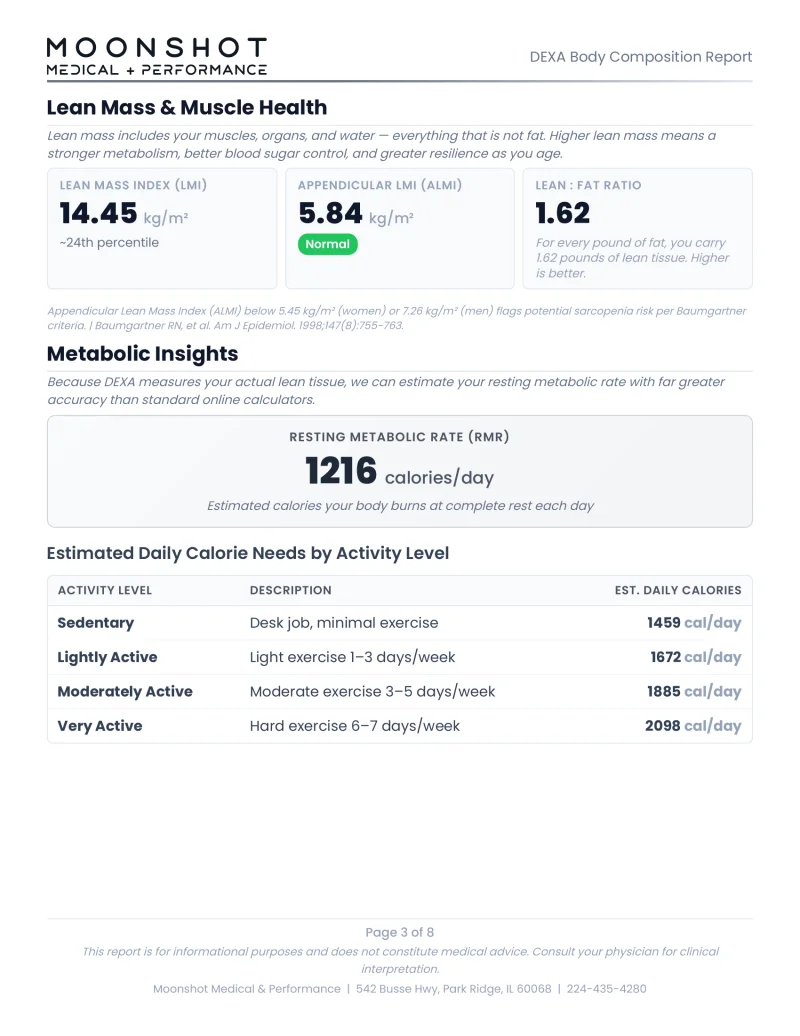
Moonshot Medical has a Hologic Horizon DEXA scanner on-site in Park Ridge — the same technology used in the clinical trials that generated the GLP-1 body composition data. A single DEXA scan gives you three measurements in one 7-minute session:
Fat Mass
Total body fat, visceral adipose tissue, and regional fat distribution. This is what you want to see decrease.
Lean Mass
Skeletal muscle by region. This is what you want to preserve. If it drops disproportionately, adjust protein, training, or dose.
Bone Density
BMD at the hip and lumbar spine, with T-scores. This is the measurement most clinics skip and most patients don't know to ask for.
When we put a patient on a GLP-1 protocol, we scan at baseline, then every 3-6 months during active treatment. We track all three measurements over time. If bone density is declining faster than expected based on the weight loss magnitude, we intervene: optimize calcium and vitamin D, adjust training recommendations, consider dose modification, and in some cases refer for bone-specific evaluation.
Most telehealth GLP-1 providers don't measure body composition at all, let alone bone density. They track scale weight and side effects. That's not medical supervision — it's prescription refill with a phone call.
The Moonshot difference: Our clinic has the DEXA scanner. Our gym (Moonshot CrossFit) is in the same building, providing the weight-bearing exercise that protects bones. Your medical provider and your coach can coordinate. Your blood work tracks vitamin D and calcium. Everything that matters for bone health during GLP-1 treatment is under one roof.
FREQUENTLY ASKED QUESTIONS
Does retatrutide affect bone density? ▾
Retatrutide itself has not been shown to directly harm bone. However, the rapid and significant weight loss it produces (up to 24% of body weight in Phase 2 trials) reduces mechanical loading on the skeleton, which is a primary stimulus for bone maintenance. Any drug that causes substantial weight loss carries this indirect risk. The magnitude of bone density change depends on the rate and total amount of weight lost, baseline bone status, age, sex, calcium and vitamin D intake, and whether the patient is doing weight-bearing exercise during treatment.
Can you lose bone density on GLP-1 medications? ▾
Yes. Published data from semaglutide and tirzepatide trials shows measurable decreases in bone mineral density during treatment, particularly at the hip and femoral neck. The STEP trials reported 1-2% BMD loss at the hip over 68 weeks. This is a mechanical unloading effect: when you weigh less, your bones experience less gravitational stress. Weight-bearing exercise, adequate calcium (1,000-1,200mg/day), and vitamin D (2,000-4,000 IU/day) are protective. DEXA monitoring tracks bone density alongside body composition so changes are caught early.
Should I get a DEXA scan before starting retatrutide? ▾
Yes. A baseline DEXA scan before starting any GLP-1 weight loss medication gives you three critical measurements: total body fat mass, lean mass by region, and bone mineral density at the hip and spine. Without a baseline, you cannot quantify changes during treatment. If bone density is already low (osteopenia or osteoporosis), your provider can adjust the treatment plan accordingly.
How do you protect bone density during weight loss? ▾
Four interventions have the strongest evidence: (1) Weight-bearing and resistance exercise — loading the skeleton signals bone to maintain or increase density. (2) Calcium intake of 1,000-1,200mg per day. (3) Vitamin D at 2,000-4,000 IU per day to support calcium absorption. (4) Adequate protein intake (1.0-1.2g per pound of ideal body weight) to preserve the muscle mass that mechanically loads bone. Avoiding excessive caloric restriction and maintaining a moderate rate of weight loss also help.
Does retatrutide cause osteoporosis? ▾
There is no evidence that retatrutide directly causes osteoporosis. However, rapid significant weight loss from any cause — including GLP-1 medications — reduces mechanical loading on bones and can accelerate bone mineral density loss, especially in patients who are already at risk (postmenopausal women, older adults, those with low baseline bone density). The risk is manageable with proper monitoring and intervention: weight-bearing exercise, calcium, vitamin D, protein, and serial DEXA scans to track BMD changes.
References
- Wilding JPH, Batterham RL, Calanna S, et al. Once-Weekly Semaglutide in Adults with Overweight or Obesity (STEP 1). N Engl J Med. 2021;384(11):989-1002.
- Jastreboff AM, Kaplan LM, Frias JP, et al. Triple-Hormone-Receptor Agonist Retatrutide for Obesity — A Phase 2 Trial. N Engl J Med. 2023;389(6):514-526.
- Wolff J. Das Gesetz der Transformation der Knochen. Berlin: Hirschwald; 1892. [Wolff's Law — bone adapts to the loads placed upon it]
- Compston JE, et al. Obesity is not protective against fracture in postmenopausal women: GLOW. Am J Med. 2011;124(11):1043-1050.
- Yu EW, et al. Bone loss after bariatric surgery: discordant results between DXA and QCT bone density. J Bone Miner Res. 2014;29(3):542-550.
- Bollag RJ, et al. Glucose-dependent insulinotropic peptide is an integrative hormone with osteotropic effects. Mol Cell Endocrinol. 2001;177(1-2):35-41.
- Iepsen EW, et al. GLP-1 receptor agonist treatment increases bone formation and prevents bone loss in weight-reduced obese women. J Clin Endocrinol Metab. 2015;100(8):2909-2917.
PROTECT YOUR BONES DURING WEIGHT LOSS
A DEXA scan measures bone density, lean mass, and fat mass in one 7-minute session. Know your baseline before starting GLP-1 treatment — and track what's changing during it.