Clinical disclaimer: Retatrutide is an investigational medication not yet approved by the FDA. This article discusses published trial data and known pharmacology for educational purposes. It is not a recommendation to use retatrutide or any specific medication. All treatment decisions should be made with a licensed medical provider based on your individual health status.
Retatrutide · Body Composition
RETATRUTIDE & MUSCLE LOSS
You're losing weight. But how much of that weight is fat, and how much is muscle you spent years building? The answer depends on the drug, the protocol, and whether anyone is actually measuring.
Medically reviewed by Missy Zammichieli, DNP, APRN, FNP-BC · Updated March 25, 2026
THE PROBLEM WITH SCALE WEIGHT
The number on the scale is the worst metric in medicine for evaluating weight loss quality. It tells you total mass changed. It cannot tell you whether that mass was adipose tissue, skeletal muscle, water, or bone mineral. And when you're on a GLP-1 receptor agonist losing 15-25% of your total body weight, the composition of what you're losing is the entire game.
Data from the STEP trials (semaglutide 2.4mg) showed that approximately 25-40% of total weight lost was lean body mass. Let that number land. If you lose 50 pounds and 35% is lean mass, you've dropped 17.5 pounds of muscle, organ tissue, and bone mineral content. On a scale, you look great. In a DEXA scanner, you've traded metabolically active tissue for a lower number.
The SURMOUNT trials (tirzepatide) showed a similar pattern. At the highest dose, participants lost an average of 22.5% of body weight over 72 weeks. Lean mass accounted for roughly a quarter to a third of that loss. Better than semaglutide's ratio, possibly because of the GIP receptor component, but still clinically significant.
This isn't a minor footnote. Muscle mass is your metabolic engine. Every pound of skeletal muscle burns approximately 6 calories per day at rest—compared to about 2 calories per pound of fat. Lose 15 pounds of muscle and your resting metabolic rate drops by roughly 90 calories per day. Over a year, that's a 33,000-calorie metabolic disadvantage that makes weight regain almost inevitable once you stop the medication.
The real question isn't "how much weight did you lose?" It's "what did you lose?" And nobody can answer that without measuring body composition directly. Scales, BMI, waist circumference—they're all proxies. DEXA is the measurement.
WHY RETATRUTIDE MAY BE DIFFERENT
Retatrutide is a triple-agonist: it activates GLP-1, GIP, and glucagon receptors simultaneously. GLP-1 and GIP are shared with tirzepatide. The glucagon receptor is what's new—and it's the piece that matters for body composition.
Glucagon has been studied for decades in metabolic physiology. Its effects on energy expenditure and substrate utilization are well-established in the research literature, even though its application in a weight loss drug is novel. Here's what glucagon receptor activation does:
Increases Resting Energy Expenditure
Glucagon infusion studies dating back to Nair et al. (1987) demonstrated that glucagon increases resting metabolic rate by 5-15% in a dose-dependent manner. Calles-Escandon and Robbins (1994) confirmed this finding and showed it was independent of catecholamine release. You burn more calories at rest—not from exercise, not from NEAT, just from existing.
Promotes Hepatic Fatty Acid Oxidation
Glucagon tells the liver to break down fatty acids for fuel instead of storing them. It upregulates carnitine palmitoyltransferase 1 (CPT-1), the rate-limiting enzyme for mitochondrial fat oxidation. In practical terms: the body preferentially burns fat rather than breaking down protein (muscle) for gluconeogenesis.
Shifts Fuel Substrate Toward Adipose Tissue
When glucagon is active, the body's fuel mix shifts. Respiratory quotient (RQ) drops, indicating a higher proportion of fat being oxidized relative to carbohydrate. This means more of the caloric deficit is "filled" by breaking down stored fat rather than catabolizing lean tissue.
May Reduce the Proportion of Lean Mass Lost
If the extra energy expenditure comes primarily from fat oxidation, and if glucagon reduces the body's need to break down muscle protein for energy, the net effect should be a more favorable ratio of fat-to-lean mass loss compared to GLP-1-only drugs. That's the hypothesis—and early data supports it.
Important context: These are known glucagon effects from decades of metabolic research. What's new is packaging them into a once-weekly subcutaneous injection alongside GLP-1 and GIP agonism. The combination is novel. The individual mechanisms are not.
WHAT THE DATA ACTUALLY SHOWS
Let's be precise about what we know and what we don't.
The Phase 2 trial (Jastreboff et al., NEJM 2023) demonstrated that retatrutide produced up to 24.2% body weight loss at 48 weeks at the highest dose (12mg). That's the most weight loss ever reported for a subcutaneous injectable in a clinical trial. But the Phase 2 trial did not include DEXA body composition endpoints. We know total weight lost. We don't know the composition from that trial.
The key dataset is the TRIUMPH-4 body composition substudy, published in The Lancet (2025). This was a dedicated analysis using DEXA to measure changes in fat mass, lean mass, and bone mineral density during retatrutide treatment. This is exactly the kind of data that matters.
What TRIUMPH-4 showed: retatrutide produced substantial fat mass reduction with a comparatively favorable lean mass preservation ratio. The proportion of weight lost as lean mass was lower than what's typically seen in semaglutide trials using DEXA endpoints. The absolute lean mass loss was not zero—no weight loss intervention achieves zero lean mass loss—but the ratio was better.
This is consistent with the glucagon receptor hypothesis: if the drug increases resting energy expenditure through fat oxidation, you'd expect more of the caloric deficit to be covered by fat breakdown rather than protein catabolism. That's exactly what the body composition data suggests.
Honest assessment: TRIUMPH-4 is encouraging. But it's one substudy. We don't yet have large-scale, multi-site, head-to-head comparisons of retatrutide vs. tirzepatide vs. semaglutide with DEXA endpoints as the primary outcome. The mechanistic argument is strong. The preliminary data aligns with it. The definitive proof requires more and larger trials.
THE MECHANISTIC ARGUMENT
Here's the math that makes the glucagon component interesting from a body composition standpoint.
Glucagon increases resting energy expenditure (REE) by approximately 5-15% in acute infusion studies. A person with a resting metabolic rate of 1,800 calories per day who gets even a 7% sustained increase burns an extra 126 calories per day. Over 48 weeks of treatment, that's roughly 42,000 additional calories expended—the energetic equivalent of about 12 pounds of fat.
Now here's where it gets relevant to muscle: that 42,000 calories has to come from somewhere. If glucagon is simultaneously promoting hepatic fatty acid oxidation and shifting the fuel substrate toward adipose tissue, those extra calories are preferentially being pulled from fat stores. That means the body has less need to break down muscle protein via gluconeogenesis to meet its energy demands.
Think of it this way: in a standard caloric deficit (from appetite suppression alone), the body covers the gap from a mix of fat and protein catabolism. The ratio depends on how severe the deficit is, how much protein you consume, and your activity level. Add glucagon-driven fat oxidation to the equation, and you're essentially giving the body an alternative fuel pathway that spares muscle protein.
Is this proven by large RCTs with DEXA endpoints as the primary outcome? Not yet. Is the mechanistic logic sound? Extremely. Every step in the chain—glucagon increases REE, promotes fat oxidation, shifts respiratory quotient—is supported by decades of metabolic physiology research. The novel part is sustained delivery via a long-acting agonist rather than acute IV infusion.
The limitation: Acute glucagon infusion studies lasted hours, not months. Chronic glucagon receptor agonism may trigger compensatory adaptations—downregulation, counterregulatory hormone shifts—that attenuate the effect over time. The TRIUMPH-4 data suggests the benefit holds over 48+ weeks, but the degree of REE increase may be less than acute studies predict.
WHAT YOU CAN DO NOW
Regardless of which GLP-1 drug you're on—semaglutide, tirzepatide, or eventually retatrutide—these four interventions determine whether you lose fat well or lose muscle badly. The drug matters. What you do alongside it matters more.
1. Protein: 1.0-1.2g Per Pound of Ideal Body Weight
This is non-negotiable. Not 0.8g. Not "try to eat more protein." One gram per pound of your ideal body weight, minimum, every single day.
At 180 lbs ideal body weight, that's 180-216g of protein daily. That's roughly 7 ounces of chicken breast at every meal, or the equivalent. Most patients on GLP-1 drugs are eating 1,200-1,500 calories per day because of suppressed appetite. Getting 180+ grams of protein into that caloric budget requires deliberate planning—lean meats, whey protein isolate, egg whites, Greek yogurt. Every meal. Every day.
The reduced appetite from GLP-1 drugs makes this harder, not easier. Appetite suppression doesn't distinguish between protein and junk food. If you're eating less overall but not prioritizing protein, you're creating exactly the conditions that maximize muscle loss.
2. Resistance Training: 3-4x Per Week, Compound Movements
Mechanical loading is the primary signal that tells your body to preserve muscle tissue. Without it, the body has no reason not to catabolize muscle during a caloric deficit. It's metabolically expensive tissue, and if you're not using it, the body will shed it.
The prescription is straightforward: squat, hinge, press, pull. Three to four sessions per week. Compound movements that load multiple muscle groups. Progressive overload—adding weight or reps over time. This doesn't mean CrossFit metcons five days a week. It means structured strength training with adequate recovery.
Cardio-only exercise programs during GLP-1 weight loss are actively counterproductive for muscle preservation. Running, cycling, and elliptical work burn calories but provide no stimulus for skeletal muscle retention. If your "exercise plan" during weight loss is walking and the Peloton, you are choosing to lose muscle.
3. Monitor with DEXA: Actual Tissue-Level Data
A DEXA scan takes 7 minutes. It tells you exactly how much fat mass, lean mass, and bone mineral density you have, region by region. It costs less than a month of GLP-1 medication.
Get a baseline scan before starting medication. Repeat every 3-4 months during treatment. If your lean mass is dropping faster than expected, that's a signal to adjust—increase protein, add training volume, or reduce the medication dose. Without the data, you can't make that call. You're just guessing and hoping.
4. Adjust Dose If Lean Mass Drops
This is where data-driven medicine separates from telehealth scripts. If a DEXA scan shows disproportionate lean mass loss between scans, your provider should consider dose reduction, a temporary hold, or an intensified muscle preservation protocol before continuing at full dose. The goal isn't maximum weight loss. It's maximum fat loss with minimum collateral damage.
This requires a provider who looks at body composition data, not just scale weight. It requires actually having the body composition data. And it requires a willingness to deviate from the standard titration protocol based on what the data says.
HOW MOONSHOT TRACKS THIS
We don't just prescribe weight loss drugs. We measure what you're actually losing.
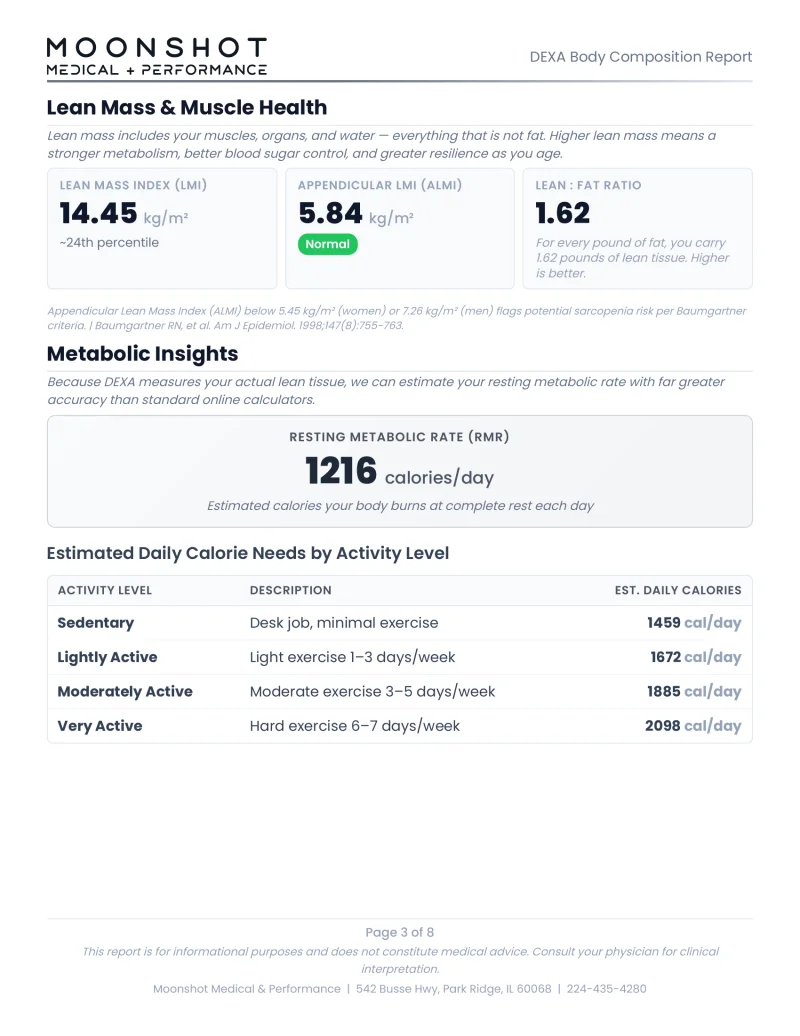
Moonshot Medical has a Hologic Horizon DEXA scanner on-site in Park Ridge. It's the same technology used in the clinical trials that generated the body composition data discussed in this article. When we put you on a GLP-1 protocol, the first thing we do is baseline your body composition—total fat mass, lean mass by region, visceral adipose tissue, bone mineral density.
Then we track it. Every 3-4 months, you scan again. We compare fat mass change vs. lean mass change. We look at regional distribution—are you losing truncal fat (good) or limb lean mass (bad)? We compare your ratio to population-level data from the clinical trials. And we adjust the protocol based on what we see.
If lean mass is holding steady while fat drops, we stay the course. If lean mass is falling disproportionately, we intervene: increase protein targets, adjust training recommendations, consider dose modification. The DEXA data turns weight loss treatment from a gamble into a measured process.
Before
Baseline DEXA scan. Know exactly where you're starting: total fat, lean mass, visceral fat, bone density.
During
Scans every 3-4 months. Track the ratio of fat loss to lean mass loss. Adjust protocol based on real data.
After
Confirm you reached your goal with the right composition. Transition to maintenance with continued monitoring.
The difference: A telehealth company sends you a vial and checks in monthly by text. We put you in a DEXA scanner and show you exactly what's happening inside your body. Then we adjust based on the data. That's what medical supervision actually means.
RETATRUTIDE + TRAINING
If you're training seriously and starting a GLP-1 drug, the programming needs to change. Not because the drug makes you weaker. Because the caloric environment you're training in has fundamentally shifted.
On retatrutide (or any GLP-1 agonist), appetite suppression means you're eating significantly less. Caloric intake may drop to 1,200-1,600 calories per day—sometimes less. That's not enough fuel to support the same training volume you ran on 2,500+ calories.
Scale Volume Before Intensity
Reduce total sets and session duration before you reduce weight on the bar. Intensity (load relative to your max) is the primary signal for muscle preservation. Volume (total work) is where recovery cost lives. In a caloric deficit, recovery is compromised. Cut the volume, keep the intensity.
Prioritize Compound Lifts
Squat, deadlift, bench press, overhead press, rows, pull-ups. These movements load the most tissue per unit of training time. In a caloric deficit, you want maximum muscle preservation stimulus with minimum recovery cost. Compound movements deliver that. Isolation work (curls, lateral raises) is a luxury when calories are low.
Protein Timing Matters
Distribute protein across 3-4 meals with 30-50g per feeding. A post-training meal with 40-50g of protein within 2 hours of training is particularly important during a deficit. Don't try to hit your daily target in one or two meals—muscle protein synthesis has a leucine threshold per meal, and exceeding it doesn't provide additional benefit.
Manage High-Intensity Conditioning
If you do CrossFit or similar high-intensity training: dial back the metcon volume during aggressive weight loss phases. A 20-minute AMRAP on 1,400 calories per day creates a recovery debt your body can't pay without catabolizing tissue. Keep 1-2 conditioning sessions per week, but make strength the priority.
The Moonshot advantage: Our gym, Moonshot CrossFit, is in the same building as the clinic. Your medical provider and your coach can actually talk to each other. Training can be adjusted based on your medication dose, your labs, and your DEXA results. That level of coordination doesn't exist when your doctor is on a screen and your gym has no idea you're on medication.
WHO THIS MATTERS MOST FOR
Body composition matters for everyone losing weight. But it's especially critical for certain populations where lean mass loss carries disproportionate consequences.
Athletes and Lifters
You've spent years building muscle. Losing 15 lbs of lean mass on a GLP-1 drug erases years of training adaptation. For competitive athletes, that's performance on the table. For recreational lifters, it's the body composition you worked for. Monitoring isn't optional for this population—it's the bare minimum.
CrossFitters
CrossFit demands strength, power, and metabolic capacity. All three depend on lean mass. If your Fran time goes up by 45 seconds after losing weight, you didn't lose the right weight. CrossFitters need DEXA tracking more than most because functional capacity degrades faster with lean mass loss than with fat retention.
Adults Over 50 (Sarcopenia Risk)
After 50, you're already losing 1-2% of muscle mass per year (sarcopenia). Add a GLP-1 drug that accelerates lean mass loss and you're compounding an age-related decline. For older adults, losing muscle during weight loss increases fall risk, reduces functional independence, and may accelerate frailty. This population needs the most aggressive monitoring and the most conservative dosing.
Anyone Who Cares About Metabolism
If you're losing weight to improve metabolic health—reduce insulin resistance, lower cardiovascular risk, improve hormonal function—losing muscle works against every one of those goals. Skeletal muscle is your primary glucose disposal site. Less muscle means worse insulin sensitivity. Losing fat while preserving muscle is the only weight loss outcome that actually improves long-term metabolic health.
FREQUENTLY ASKED QUESTIONS
Will retatrutide make me lose muscle? ▾
All weight loss drugs carry some risk of lean mass loss. The question is how much. Retatrutide's glucagon receptor activity increases resting energy expenditure and promotes fat oxidation, which may shift the ratio of fat vs. muscle lost in a favorable direction compared to GLP-1-only drugs. But without resistance training and adequate protein, you will still lose muscle on any weight loss medication. The drug isn't a substitute for the work.
Can I build muscle on retatrutide? ▾
Building muscle during active weight loss is difficult on any protocol because you're in a caloric deficit. What's more realistic is muscle preservation—maintaining the lean mass you have while losing primarily fat. With sufficient protein (1.0-1.2g per pound of ideal body weight), progressive resistance training 3-4x per week, and body composition monitoring via DEXA, most patients can keep lean mass losses under 10-15% of total weight lost.
Is retatrutide better than tirzepatide for body composition? ▾
Retatrutide has a mechanistic advantage: the glucagon receptor component increases resting energy expenditure and promotes fat oxidation, which tirzepatide lacks. The TRIUMPH-4 body composition substudy showed favorable fat-to-lean mass loss ratios. However, head-to-head trials with DEXA endpoints comparing the two drugs directly haven't been completed. The mechanistic argument is strong, but the definitive comparison data isn't available yet.
Do I need DEXA scans while on retatrutide? ▾
If you care about what you're actually losing—yes. A scale shows total weight change. DEXA shows exactly how much is fat, how much is muscle, and where on your body the changes are happening. Without DEXA, you're making treatment decisions based on incomplete data. We recommend scans at baseline, then every 3-4 months during active treatment. If lean mass drops disproportionately, your provider can adjust dose, protein targets, or training protocol before the damage compounds.
How much protein do I need on retatrutide? ▾
1.0 to 1.2 grams per pound of ideal body weight, daily. This is non-negotiable during GLP-1 weight loss. At 180 lbs ideal body weight, that's 180-216g of protein per day. The reduced appetite from retatrutide makes hitting this target harder, not easier—which is why it needs to be tracked deliberately. Protein timing matters too: distribute intake across 3-4 meals with 30-50g per feeding rather than trying to get it all in one sitting.
Can I still do CrossFit on retatrutide? ▾
Yes, and you should be training. But you may need to adjust how. Reduced caloric intake affects recovery capacity, so volume may need to come down before intensity does. Prioritize compound lifts (squat, deadlift, press, pull) over high-volume metcons during active weight loss. Work with a coach who understands training in a caloric deficit. At Moonshot, the gym is next door to the clinic—your training and your medical protocol can actually be coordinated.
References
- Wilding JPH, Batterham RL, Calanna S, et al. Once-Weekly Semaglutide in Adults with Overweight or Obesity (STEP 1). N Engl J Med. 2021;384(11):989-1002.
- Jastreboff AM, Kaplan LM, Frias JP, et al. Triple-Hormone-Receptor Agonist Retatrutide for Obesity—A Phase 2 Trial. N Engl J Med. 2023;389(6):514-526.
- Nair KS, et al. "Leucine, glucose, and energy metabolism after 3 days of fasting." Diabetes. 1987;36:696-702.
- Calles-Escandon J, Robbins DC. Loss of early phase of insulin release in humans impairs glucose tolerance and blunts thermic effect of glucose. Diabetes. 1987;36(10):1167-1172. — Calles-Escandon J. Glucagon and resting energy expenditure. Int J Obes. 1994;18:S85-S87.
- TRIUMPH-4 Body Composition Substudy. Retatrutide and body composition: a DEXA analysis. The Lancet. 2025. [TRIUMPH-4 program data]
- Heymsfield SB, Coleman LA, Miller R, et al. Effect of Bimagrumab vs Placebo on Body Fat Mass Among Adults With Type 2 Diabetes and Obesity (STEP sub-analysis, lean mass data). JAMA Netw Open. 2021;4(1):e2033457.
- Jastreboff AM, Aronne LJ, Ahmad NN, et al. Tirzepatide Once Weekly for the Treatment of Obesity (SURMOUNT-1). N Engl J Med. 2022;387(3):205-216.
KNOW WHAT YOU'RE LOSING
Scale weight is noise. Body composition is signal. Get a DEXA scan before, during, and after GLP-1 treatment—and make decisions based on real data.