Body Composition
DEXA SCAN COST:
$150
A DEXA body composition scan costs $150 at Moonshot Medical in Park Ridge, IL. Hologic Horizon machine, 7-minute scan, results reviewed same-day. No referral needed.
Medically reviewed by Missy Zammichieli, DNP, APRN, FNP-BC · Updated April 2026
Book Your DEXA Scan — $150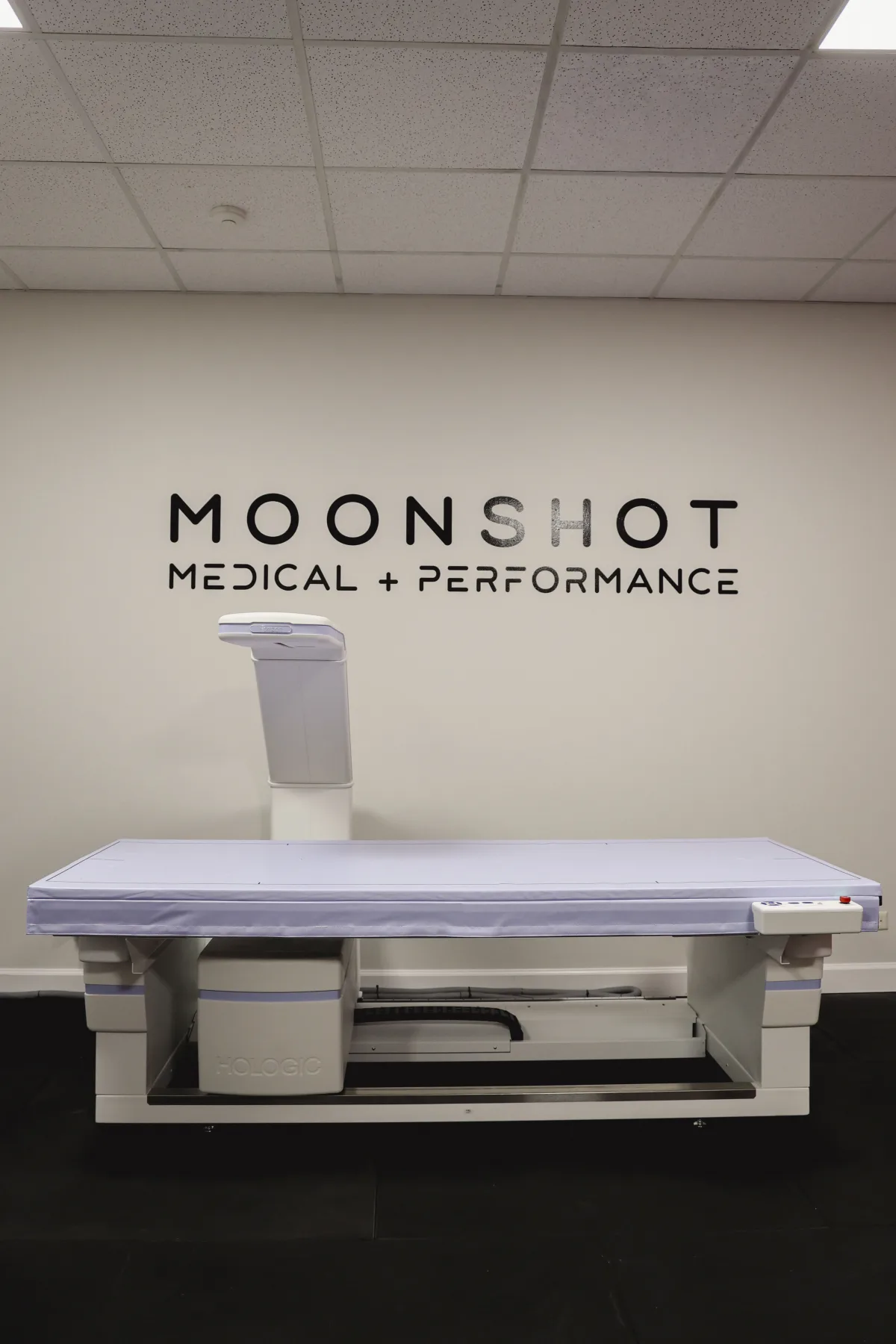
WHAT YOU GET FOR $150
Your $150 DEXA scan at Moonshot Medical is a full-body composition analysis on a Hologic Horizon — the same medical-grade machine used in university research facilities and clinical trials. This isn't an estimate or an algorithm. It's a direct measurement using dual-energy X-ray absorptiometry, the gold standard for body composition assessment.
The scan takes about 7 minutes. You lie on a padded table while the scanner arm passes over your body. It's painless, non-invasive, and uses less radiation than a cross-country flight. Your results are ready immediately and reviewed with a provider the same day.
Body Fat Percentage by Region
Total body fat percentage plus a breakdown by region — arms, legs, trunk, android (belly), gynoid (hips). You'll see exactly where you carry fat and how it's distributed, not just a single number.
Lean Muscle Mass
Total lean mass plus regional breakdown. This is how you know if you're building muscle, preserving it during a cut, or losing it. Appendicular lean mass index (ALMI) flags sarcopenia risk.
Bone Mineral Density
Full bone density measurement — the same data used for osteoporosis screening. T-scores and Z-scores for spine and hip. You get body composition and bone health in a single scan.
Visceral Fat Measurement
Visceral adipose tissue (VAT) — the metabolically dangerous fat surrounding your organs. This is the fat most strongly correlated with cardiovascular disease, type 2 diabetes, and metabolic syndrome. A scale can't measure this.
Same-day provider review included. Your results aren't handed to you in a folder. A provider reviews the scan with you, explains what the numbers mean, and discusses implications for your training, nutrition, or medical program. This is included in the $150 — no separate consultation fee.
DEXA SCAN COST COMPARISON
DEXA scan prices vary widely depending on where you go. Here's how Moonshot Medical compares to other options in the Chicago area and nationally:
| Facility Type | Typical Cost | Referral Needed? | Notes |
|---|---|---|---|
| Moonshot Medical | $150 | No | Hologic Horizon, same-day results review with provider, walk-in friendly |
| Hospital / Imaging Center | $200-350 | Usually yes | Higher facility fees, may only offer bone density (not body composition) |
| University Research Lab | $75-150 | No | Limited hours, may have waitlists, no medical provider review |
| Groupon / Discount DEXA | $65-90 | No | Machine-generated report only, no provider review, no custom reporting, no actionable guidance |
| InBody / Bod Pod Facility | $25-75 | No | Cheaper but significantly less accurate — not true DEXA |
Why the price range matters: Hospital DEXA scans come with facility fees, scheduling delays, and often require a physician referral. University labs are cheaper but have limited availability and no medical context for your results. InBody and Bod Pod are not DEXA — they use different technology with significantly lower accuracy. $150 for a medical-grade Hologic DEXA with same-day provider review is the best value in the category.
"WHY IS YOUR DEXA $150 WHEN GROUPON HAS THEM FOR $65?"
We get this question. It's a fair one.
The scan itself may use similar hardware. But the difference in price comes down to what you actually walk away with.
Most $65-90 DEXA providers hand you the standard machine-generated report. It's a printout of raw data tables — numbers and percentages in a format designed for radiologists, not patients. It's dense, hard to interpret, and not especially useful from an action standpoint. You leave knowing some numbers but not knowing what to do about them.
At Moonshot, we built a custom reporting system that takes the raw data from the Hologic Horizon and presents it in a way you can actually understand and use. Your body fat distribution by region, lean muscle mass, visceral fat levels, and how each metric tracks over time — all presented visually with clear context about what's good, what needs attention, and what to focus on.
Every scan also includes a medical consultation. We walk through your results, answer your questions, and help you understand what to prioritize based on your specific goals — whether that's fat loss, muscle building, metabolic health, or tracking progress on TRT or GLP-1 therapy.
Most discount providers don't include that. You get a printout and a handshake.
The difference isn't the machine — it's the interpretation, the reporting, and the guidance. That's what turns a $65 data dump into a $150 actionable health assessment.
SEE THE DIFFERENCE
Standard Machine-Generated Report
Adipose Indices
| Measure | Result | YN | AM |
|---|---|---|---|
| Total Body % Fat | 22.9 | 61 | 42 |
| Fat Mass/Height² | 6.30 | 63 | 44 |
| Android/Gynoid Ratio | 1.02 | ||
| Est. VAT Mass (g) | 310 | ||
| Est. VAT Area (cm²) | 64.2 |
YN = Young Normal · AM = Age Matched
Dense, technical, hard to interpret without medical training. What does "Android/Gynoid Ratio 1.02" mean for your health?
Moonshot Custom Report
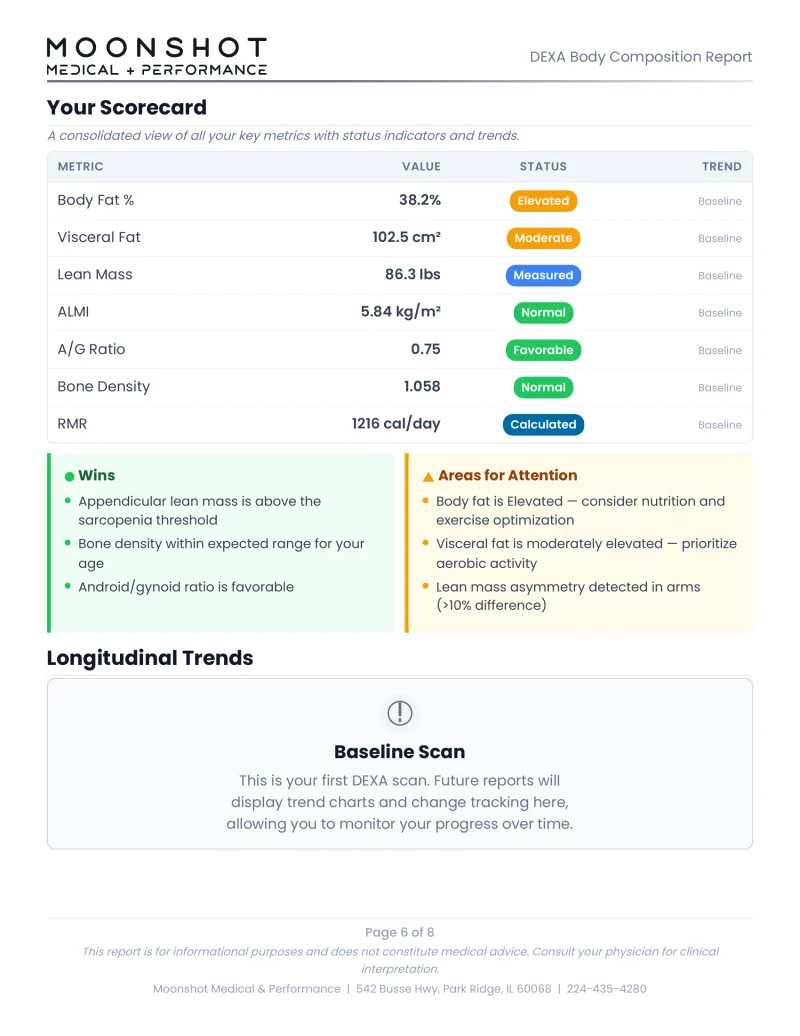
Clear metrics, color-coded status indicators, trend tracking, and actionable wins/attention items. You know exactly where you stand.
BOOK YOUR DEXA SCAN
$150. Hologic Horizon. Results reviewed same-day. No referral needed. Park Ridge, IL.
IS A DEXA SCAN WORTH $150?
A bathroom scale tells you one number: total weight. That number doesn't distinguish between fat, muscle, bone, and water. It can't tell you if you're losing fat or losing muscle. It can't tell you if you're gaining dangerous visceral fat while your total weight stays the same. It can't tell you if your training program is actually working.
Here's the problem that costs people months of wasted effort: someone starts a program, steps on a scale, and sees the number drop 15 lbs. They celebrate. But without a DEXA scan, they don't know if those 15 lbs were 12 lbs of fat and 3 lbs of muscle (solid result) or 5 lbs of fat and 10 lbs of muscle (a disaster they should have corrected at week 4).
The $150 investment pays for itself by eliminating guesswork. You get objective data on what's actually happening inside your body, and you can course-correct before wasting 3-6 months on a program that isn't delivering the results you think it is.
Body Recomposition Tracking
Gaining muscle while losing fat? Your scale won't show much change — but your DEXA scan will show a dramatic shift in body composition. This is the only way to verify recomposition is actually happening.
Muscle Preservation During Weight Loss
The biggest risk during caloric restriction is losing muscle along with fat. A DEXA scan every 3 months tells you whether your protein intake and training load are preserving lean mass. If muscle is dropping, you adjust before it's too late.
Visceral Fat Trending
Visceral fat is the number one modifiable risk factor for metabolic disease. DEXA quantifies it directly. Trending it over time shows whether your program is reducing the fat that actually threatens your health — not just subcutaneous fat you can see in the mirror.
Program Accountability
Objective data drives better decisions. When you know you're getting scanned in 3 months, you're more likely to stick to the plan. And if the results don't match the effort, you have the data to fix your approach rather than guessing.
The math: Most people spend $100-300/month on gym memberships, supplements, meal prep, and coaching. A $150 DEXA scan every 3-4 months (that's $37-50/month) tells you whether all of that spending is actually working. It's the cheapest way to know if your investment in health is paying off.
WHEN TO GET A DEXA SCAN
Timing matters. Here's when a DEXA scan delivers the most value:
Before Starting a New Program
Get a baseline before you change anything — new diet, new training program, new supplement stack. Without a starting point, you can't measure progress. This is the single most important time to scan.
Every 3-6 Months During a Program
Body composition changes slowly. Scanning more often than every 8-10 weeks usually doesn't show meaningful change. Every 3 months is the sweet spot for tracking progress and making adjustments.
During TRT or GLP-1 Programs
Hormone optimization and GLP-1 weight loss programs change body composition rapidly. DEXA tracking every 3-4 months verifies that you're losing fat (not muscle) and that lean mass is trending in the right direction. Moonshot's hormone memberships include 2 DEXA scans per year.
Annual Health Baseline
Even if you're not actively training, an annual DEXA scan tracks age-related changes in muscle mass, bone density, and fat distribution. Catching sarcopenia or osteopenia early gives you years of runway to reverse it.
DEXA VS CHEAPER ALTERNATIVES
There are cheaper ways to estimate body composition. They're cheaper because they're less accurate. Here's an honest comparison:
| Method | Cost | Accuracy | What It Measures |
|---|---|---|---|
| DEXA (Hologic Horizon) | $150 | Gold standard (1-2% error) | Fat, lean mass, bone density by region + visceral fat |
| Bod Pod | $45-75 | Good (2-3% error) | Total body fat % only — no regional data, no bone density |
| InBody (BIA) | $25-50 | Moderate (3-5% error) | Estimated fat and lean mass — affected by hydration, food, exercise |
| Skinfold Calipers | $10-30 | Low-moderate (3-8% error) | Subcutaneous fat only — operator-dependent, misses visceral fat |
| Smart Scale (BIA) | $30-100 (one-time) | Low (5-10% error) | Rough body fat estimate — highly variable day to day |
The accuracy gap matters more than it looks. A 5% error on body fat means the difference between 20% body fat (healthy, lean) and 25% (average, not lean). That's the difference between "your program is working" and "you need to change something." Cheap tests give you a number — DEXA gives you the right number.
InBody and BIA devices are also highly sensitive to hydration status, recent meals, and exercise. Your reading can swing 3-5% depending on when you drank water. DEXA isn't affected by these variables, which makes it the only reliable way to track changes over time. For a deeper dive, read our DEXA vs Bod Pod comparison.
Bottom line: If you just want a rough estimate for curiosity, a $25 InBody scan is fine. If you're making training, diet, or medical decisions based on body composition data — or if you're spending real money on a program and need to know if it's working — DEXA is the only method accurate enough to trust.
INSURANCE AND DEXA SCANS
Insurance coverage for DEXA scans depends entirely on why you're getting the scan. Here's the honest breakdown:
Covered: Bone Density Screening
Insurance typically covers a bone density DEXA scan for women 65+, men 70+, postmenopausal women under 65 with risk factors, patients on long-term corticosteroids, and anyone with a history of fragility fractures. This is a targeted scan of the hip and spine for osteoporosis screening — it does not include body composition data.
Not Covered: Body Composition
Insurance does not cover DEXA scans for body composition analysis. This applies everywhere — not just at Moonshot Medical. No insurance plan pays for body fat percentage, lean mass, or visceral fat measurement. Body composition DEXA is a cash-pay service at every facility that offers it.
The upside of cash-pay: No referral paperwork. No insurance pre-authorization. No surprise bills 3 months later. No facility fees. You pay $150, get your scan, and walk out with your results reviewed. The process takes 20 minutes total. Cash-pay is actually simpler for body composition DEXA than navigating insurance would be even if it were covered.
BUNDLES THAT INCLUDE DEXA
DEXA scans are most valuable when combined with other data. Here are the ways to get a DEXA scan at Moonshot Medical:
$150
Standalone DEXA Scan
Full body composition report + same-day provider review. Walk in, scan, done.
Best Value
$405
Performance Baseline Bundle
DEXA scan + comprehensive blood panel. Save $30 vs. booking separately. The complete picture — body composition plus internal health markers.
Included
Hormone & GLP-1 Members
Hormone optimization memberships include 2 DEXA scans/year. GLP-1 weight loss programs include DEXA tracking to verify fat loss vs. muscle loss.
Why pair DEXA with blood work: DEXA tells you what's happening to your body composition. Blood work tells you why. High visceral fat on DEXA plus elevated fasting insulin on labs gives you a clear action plan. One data source is informative — both together are actionable. The Performance Baseline Bundle exists for this reason.
DEXA SCAN COST FAQ
How much does a DEXA scan cost?
A DEXA body composition scan costs $150 at Moonshot Medical in Park Ridge, IL. This includes a full body composition report (body fat %, lean muscle mass by region, bone mineral density, visceral fat, appendicular lean mass index) plus same-day review with a provider. No referral needed. Hospital-based DEXA scans typically run $200-350 and often require a physician referral.
Does insurance cover DEXA scans?
Insurance covers bone density DEXA scans for qualifying patients — typically women 65+, men 70+, or those with osteoporosis risk factors. However, insurance does not cover DEXA scans for body composition analysis. Body composition DEXA is a cash-pay service at all facilities, not just Moonshot Medical. The $150 price at Moonshot is straightforward with no surprise billing.
How often should I get a DEXA scan?
For most people, every 3-6 months is ideal. Get a baseline scan before starting a new program, then follow up at 3-month intervals to track changes. Patients on TRT or GLP-1 programs typically scan every 3-4 months to verify body recomposition. Annual scans work well for general health monitoring. Scanning more often than every 8-10 weeks usually doesn't show meaningful change.
Is a DEXA scan worth it?
Yes — if you care about body composition, not just weight. A scale tells you total weight. A DEXA scan tells you exactly how much is fat, muscle, and bone — and where it's distributed. This matters because someone losing 15 lbs could be losing 15 lbs of fat (great), 10 lbs of muscle and 5 lbs of fat (bad), or anything in between. Without a DEXA scan, you're guessing. The $150 investment prevents months of misguided training and diet decisions.
What's the difference between a bone density DEXA and a body composition DEXA?
Same machine, different analysis. A bone density DEXA (DXA) measures bone mineral density at the hip and spine to screen for osteoporosis. A body composition DEXA is a full-body scan that measures body fat percentage by region, lean muscle mass, visceral fat, and bone density. At Moonshot Medical, the $150 body composition scan includes bone density data — you get both in a single 7-minute scan.
Can I get a DEXA scan without a doctor's referral?
Yes. At Moonshot Medical in Park Ridge, IL, no referral is needed for a DEXA body composition scan. Book directly online and walk in for your 7-minute scan. Hospital-based DEXA scans typically require a physician referral, which is one reason many people choose direct-access facilities like Moonshot Medical.
Why is your DEXA scan $150 when I can find them for $65 on Groupon?
The scan itself uses similar hardware. The difference is what you walk away with. Most discount DEXA providers hand you a machine-generated printout — dense data tables designed for radiologists, not patients. At Moonshot, we built a custom reporting system that presents your body fat, lean mass, visceral fat, and regional distribution in a clear, visual format with color-coded status indicators. Every scan also includes a medical consultation where we walk through your results and help you understand what to focus on. Most $65-90 providers don't include that — you get a printout and a handshake.
BOOK YOUR DEXA SCAN — $150
Hologic Horizon. 7-minute scan. Same-day results review. No referral needed.
Book DEXA ScanPrefer to talk first? Call 224-435-4280
Medical Disclaimer: This article is for informational purposes only and does not constitute medical advice, diagnosis, or treatment. DEXA body composition scans are not a substitute for medical evaluation. Results vary by individual. Radiation exposure from a DEXA scan is minimal (approximately 0.001 mSv, less than a day of natural background radiation). Always consult a qualified healthcare provider for medical decisions. No provider-patient relationship is established by viewing this content.